FCC reaffirms ‘finality of judgements’ doctrine
• Shuts door on ‘perpetual litigation’ by rejecting plea against MDA filed by landowner’s legal heirs
• Rules dispute a ‘private matter’, doesn’t involve enforcement of public’s fundamental rights
• Matter previously adjudicated up to Supreme Court
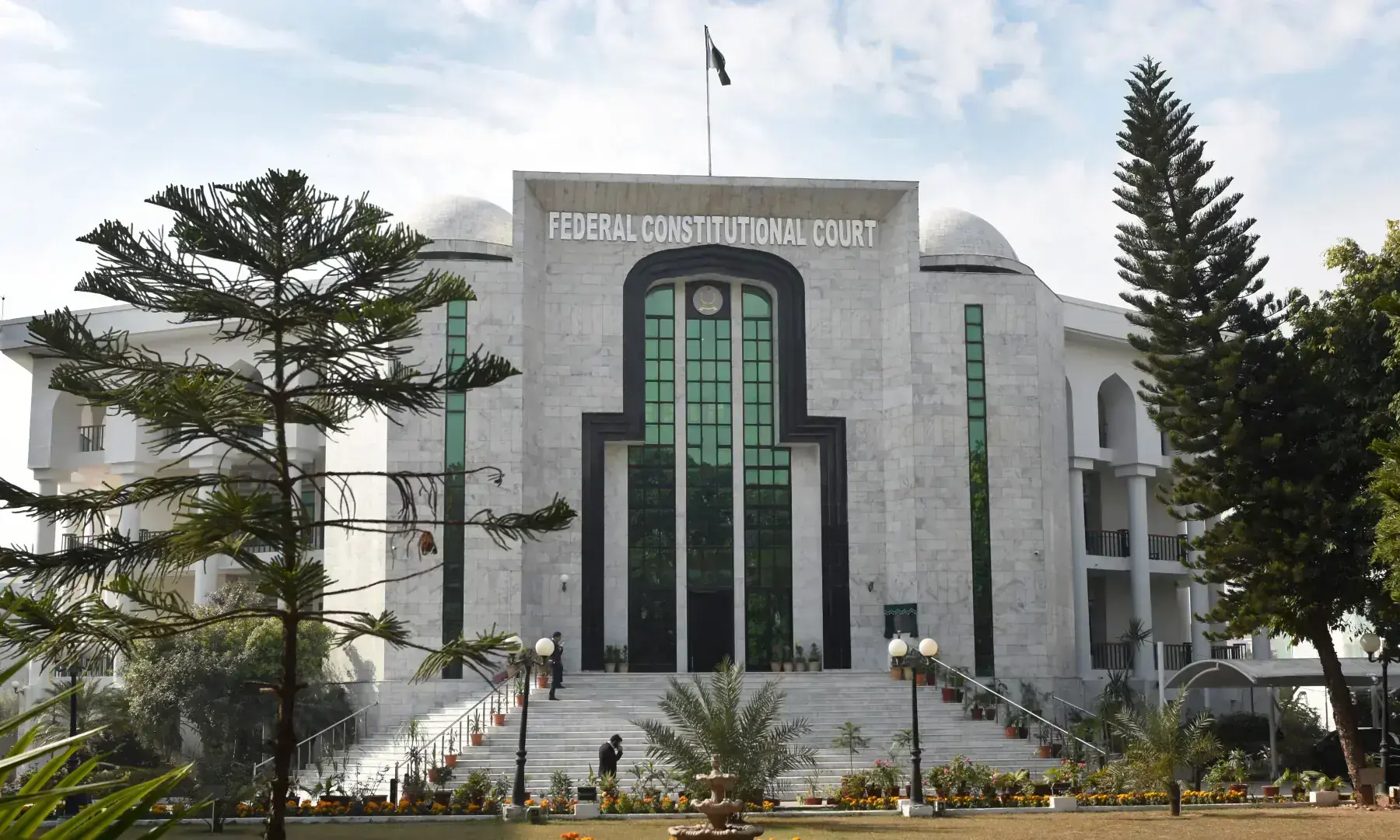
ISLAMABAD: The Federal Constitutional Court (FCC) on Thursday reaffirmed the doctrine of finality of judgements and shut the door on what the court termed ‘perpetual litigation’, in a long-running land acquisition dispute involving the Multan Development Authority (MDA).
Headed by FCC Chief Justice Aminuddin Khan, and also including Justice Ali Baqar Najafi, a two-member bench dismissed the review petition, filed by the legal heirs of one Syeda Nasreen Zohra, observing that the petitioners could not be permitted to reopen concluded litigation through the backdoor of constitutional jurisdiction.
“If such a course were to be sanctioned, it would render Article 188 of the Constitution [review petitions] redundant and destabilise the doctrine of finality,” the FCC chief justice observed in the seven-page judgement he authored.
“The Constitution does not envisage perpetual litigation,” the judgement stated, adding that judicial discipline demanded that there must be a terminus to adjudication.
The primary question for determination before the FCC was whether the review petition challenging the previous judgement of the Supreme Court under Article 184(3) of the Constitution — as it was before the 27th Amendment, and now Article 175E(3) — was maintainable or not.
‘Private dispute’
The dispute traces back to land acquisition proceedings involving the late Syeda Nasreen Zohra and the Punjab government through the Communication and Works Department, Lahore, and the Multan Development Authority.
The matter had previously been adjudicated up to the SC.
Justice Khan noted that the dispute at hand, which concerned compensation arising out of land acquisition proceedings, had traversed the entire judicial hierarchy, including two rounds of appeals before the SC and a petition filed under Article 184(3) — (enforcement of fundamental rights), now omitted under the 27th Constitutional Amendment.
“The grievance articulated is not one that implicates the enforcement of fundamental rights of the public at large; rather, it is a continuation of a private dispute between the legal representatives of a landowner and the provincial government,” Justice Khan explained.
“Thus the invocation of a review petition against the Sept 12, 2024 SC order sustaining the office objection, in which it was held that the petition filed under Article 184(3) was not competent, appears to be an attempt by the petitioner to reopen a concluded controversy under the guise of constitutional enforcement,” the judgement regretted.
The court noted that Article 184(3), prior to the 27th Constitutional Amendment, and now Article 175E(3) of the Constitution, conferred original jurisdiction on the FCC only in matters of public importance rela-ting to the enforcement of fundamental rights.
The judgement also cited the 1988 Benazir Bhutto case, in which the SC had held that the jurisdiction under Article 184(3) was extraordinary in character and intended to address issues affecting the public at large rather than to serve as a forum for the redress of individual grievances arising out of concluded litigation.
The FCC further cited the 2011 Watan Party case and the 2015 District Bar Association Rawal-pindi case to recall that Article 184(3) was not an appellate or revisional provision.
It does not constitute an avenue for re-agitating matters already adjudicated upon through the regular judicial hierarchy.
The FCC, while citing the 1993 Nawaz Sharif case, observed that the finality of judgements was indispensable to the administration of justice and that unending re-litigation undermined certainty and institutional authority.
Published in Dawn, March 6th, 2026