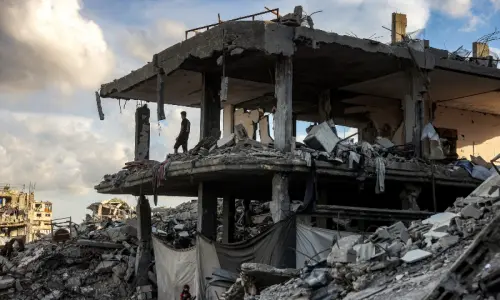
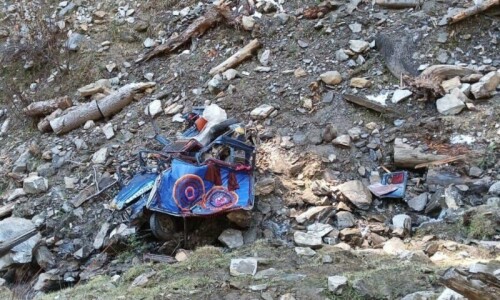
KARACHI, Oct 14: The government officials responsible for safety and planning of buildings in the city seem confident and insist that new buildings -– constructed after 1980s — are strong enough to sustain any earthquake up to the magnitude of 6.5 on Richter Scale.
However, various NGOs and professional bodies dispute this claim. They maintain that although designs and plans of the buildings may be in accordance with the prescribed rules, the implementation and inspection process is faulty as proper and sufficient material – steel, concrete, etc., – is not used by greedy builders and this is overlooked by corrupt elements in the rank and file of regulators and monitors.
The city is located in the seismic area which is classified as Zone 2B (upper-moderate) and all high-rise buildings are designed to sustain an earthquake of up to 6.5 intensity, claim government officials.
Earlier, the city had been placed in the lower-moderate level earthquake zone, but after re-evaluation, it was put in the higher zone (Zone 2B) and accordingly the building codes and regulations were updated which, the officials claim, are now being implemented.
Officials in the city government and Karachi Building Control Authority claim that they have a perfect mechanized system with expertise to regulate and monitor construction activities. But they regret that they do not have regulatory control over those areas falling in the jurisdiction of the Defence Housing Authority and cantonment boards.
Referring to the government buildings, these officials say that their plans are also not submitted with the city government or the KBCA. Usually it is the Public Works Department (PWD) and Communications and Works Department (C&WD), both of which are responsible for the design and construction of government buildings.
They, however, fear that any earthquake could pose threat to about 200 old buildings, many of which were protected under the Sindh Cultural Heritage Protection Act. These buildings have already been declared dangerous by the government as they could collapse any time. They suggest that people living in these buildings be relocated, like those shifted and resettled to make way for the Lyari Expressway project.
Independent experts, however, fear extensive loss of life and property in case Karachi is hit by an earthquake with the magnitude and intensity of the one that hit the country on October 8.
They agreed that the designs of most of the residential or commercial buildings are mostly prepared by the qualified architects and, of course, in accordance with the prescribed laws, rules and regulations and the designs are also approved by the controlling authority after proper vetting. But, they point out, it is at the implementation stage that builders, captive to their greed, use substandard and poor quantity construction material. And this, of course, is done in connivance with the staff of the regulating and monitoring agencies, they claim.
These experts say that if Karachi is hit by an earthquake of 6.5 magnitude, many of the city’s high-rise buildings designed without adequate soil testing, and constructed with poor quality material in violation of the building codes, and skipped in the proper monitoring process, would come down like a house of cards.
Chief of the Pakistan Council of Architects and Town Planners (PCATP) Shahab Ghani Khan, indicating that Karachi is in the upper moderate seismic zone 2B having a magnitude level between 5.5 and 6.5 on the Richter Scale, says that any earthquake of more than 6.5 on Richter Scale can play havoc with the city, though the chances of such a massive earthquake are remote.
He observes that buildings are designed as per the prescribed building code but their execution is not monitored strictly. Strength of any structure depends upon the quality and quantity of construction material that has to be used as per the specifications and drawings shown in the design. Unfortunately, these are never followed, according to him.
Mr Khan points out that in major commercial projects, designers or consultants are involved only for preparing their designs but their supervisory services are not hired at physical construction stage because it would increase the overall project cost. The builders would also resort to save money while selecting quality and quantity of steel and cement. He suggests that the government should evolve a proper monitoring system in this regard by involving private sector auditors.
Experts and social activists of an NGO, Shehri, who have been agitating against unauthorized and illegal constructions in the city, say that it is not primarily the intensity of an earthquake that causes deaths, but the defective construction that results in collapse of structures in even a minor jolt. The activists, Roland D’Souza and Amber Alibhai, say that the city has the largest concentration of illegal, unauthorized and badly constructed buildings than anywhere in the country although it is in the upper-moderate seismic classification.
Referring to the fate of Margalla Towers in Islamabad, they quote the Capital Development Authority as saying that “completion certificate was not issued to it.” The KBCA, cantonment boards and DHA may also offer the same excuse if many poorly constructed buildings in the city are brought down by a quake, they remark.
The deplore that while individuals and advocacy groups, including the Shehri and the Urban Resource Centre, have been highlighting these problems in seminars, symposiums and numerous public interest litigations, but generally the government’s reaction is ‘regularization’. “Unless citizens demand change and actively oppose mafias and their corrupt friends in the Establishment, life will go on as it does and masses will continue to remain helpless victims of such catastrophes.” They call for campaigns to be launched against further construction of such dangerous buildings in the city.
Chief of the Institution of Engineers Pakistan Zaffar Zuberi says that the devastation by the quake in the northern parts of the country has exposed our capacity and capability viz-a-viz disaster management.
Technically, he says, the Aga Khan Hospital building is the only structure in Karachi in the construction of which international standards have been followed. Therefore, he says, it can sustain a major quake but most of the old buildings in the old city areas like Lyari, Mithadar, Kharadar etc., may not survive a moderate or severe jolt.
Mr Zuberi observes that the houses in katchi abadis are often built without considering structural safety. They are no different from those built in Muzaffarabad and may disappear if shaken by a quake of over 6.5 intensity on Richter Scale.
He further observes that there is no infrastructure in Karachi to cope with such a disaster. The civil defence and the fire brigades do not have enough personnel or equipment to deal with such a emergencies.
Syed Zaigham Jaffery of the Institute of Architects Pakistan says that many years back, KDA had prepared the Karachi Emergency Relief Plan (KERP) which was based on a model developed for the entire Pacific region, where many countries have adopted the plan and made it into law. He says that this plan may be implemented through the existing officials without putting any additional burden at all on provincial or lower administrations.