IMF mission concludes visit; staff acknowledges progress in key areas


 11
11

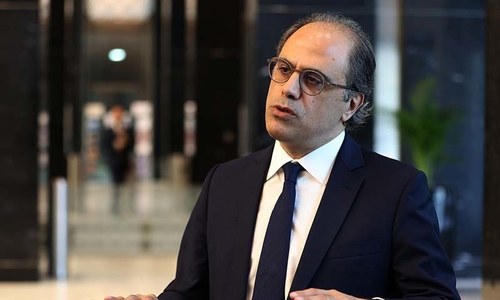
An International Monitory Fund (IMF) mission — led by its Pakistan, Middle East and Central Asia Mission Chief Ernesto Ramirez Rigo — concluded a five-day visit to Pakistan on Friday, highlighting progress in multiple key areas in a press statement.
According to a press release posted on the IMF website, the country's economic programme is off to a promising start, but decisive implementation of reforms is critical to pave the way for stronger and sustainable growth.
The IMF mission had visited Islamabad and Karachi from September 16-20 to take stock of economic developments since the start of the Extended Fund Facility (EFF) and discuss progress in the implementation of economic policies.
Mission Chief Ernesto Ramirez Rigo commented after concluding the visit, “While the authorities’ economic reform programme is still in its early stages, there has been progress in some key areas. The transition to a market-determined exchange rate has started to deliver positive results on the external balance, exchange rate volatility has diminished, monetary policy is helping to control inflation, and the State Bank of Pakistan (SBP) has improved its foreign exchange buffers."
He further said, “There has been a significant improvement in tax revenue collections, with taxes showing double-digit growth net of exporters' refunds. Moreover, the Federal Board of Revenue (FBR) is undertaking significant steps to improve tax administration and its interface with taxpayers.
"Staff and the authorities have analyzed the worse than expected fiscal results of FY2018-19, which were partially the result of one-off factors and should not jeopardise the ambitious fiscal targets for FY2019-20," he noted. "Importantly, the social spending measures in the programme have been implemented."
Talking about the economic outlook for the country, the mission chief said, “The near-term macroeconomic outlook is broadly unchanged from the time of the programme approval, with growth projected at 2.4 per cent in FY2019-20, inflation expected to decline in the coming months, and the current account adjusting more rapidly than anticipated."
"However, domestic and international risks remain, and structural economic challenges persist. In this context, the authorities need to press ahead with their reform agenda," he warned.
“In order to complete the first review, an IMF staff team plans to return to Pakistan in late-October to assess the end-September program targets," he added.
IMF mission chief visits power minister, discusses reforms
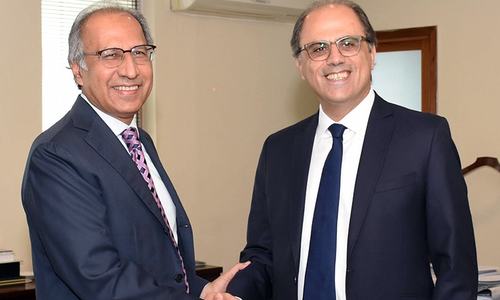
Earlier in the day, Rigo called on Federal Minister for Power Omar Ayub Khan at his office and reportedly expressed his satisfaction with the performance of the power sector, terming it encouraging.
According to another press release, issued by the power division, Rigo appreciated efforts made by the division towards meeting its targets. He also appreciated efforts towards formulating the new renewable energy policy, the release.
The IMF mission chief said that power sector reform is an integral part of the IMF programme. He appreciated the shift towards utilisation of indigenous resources leading towards the reduction of prices of electricity in the country.
The development, he said, will ultimately benefit all walks of life.
The minister also informed the IMF delegation regarding achievements made by the division pertaining to "record recoveries" and reduction in line losses. He said that due to the concerted efforts of the power division, the circular debt had shown considerable reduction in growth.
According to the statement, the circular debt had been growing at the rate of Rs38 billion per month, while its growth at the end of the last financial year was reduced to Rs26bn per month.
In July 2019, results were even more encouraging as growth was further arrested to Rs18bn per month, the minister said; adding that a comprehensive campaign against power theft and defaulters was yielding results.
Omar Ayub Khan also apprised the delegation on the technical and system improvement measures undertaken by the power division. He further said that 80 per cent of the total feeders in the country are now load management free.
He also informed the delegation about the new policy under which the government is aiming to increase the share of indigenous resources in power generation and cutting down the prices of electricity for consumers besides reducing dependency on imported fuels.
"We intend to increase the share of indigenous resources upto 75pc," he said.