0
0

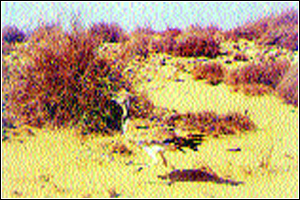 MULTAN, Jan 14: Houbara bustard is falling a prey to ruthless hunting in the range lands of Balochistan, Sindh and southern Punjab under the cover of ‘sustainable hunting’ and diplomacy.
The majestic desert bird is hunted not only as a sport but for its meat, which is considered as aphrodisiac.
It comes to Chaghi, Kharan, Thar, Cholistan and Thal deserts with the fall of winter in its breeding grounds of Central Asian states.
As spring sets in, it returns, along with other migratory birds, to its summer sanctuaries.
According to an estimate, over 30,000 houbaras come to Pakistan every year. As such, experts say, Pakistani range lands constitute the largest chunk of winter feeding ground of the bird.
Hunting houbara has been a favourite game for Arab falconers since ages. The bird did land in some Middle Eastern countries during winter in past but, owing to its extensive hunting, it abandoned the Arab deserts.
In the 1970s and 80s, the ‘guests’ played havoc with the bird and ecosystem of the range lands in Pakistan with excessive hunting by bringing heavy 4x4 vehicles to the deserts along with other modern-day game accessories. Their frequent visits not only even proved fatal to houbara but also caused destruction to other wild animals and disturbed their natural biological cycle.
In the 80s, scientists and various wildlife organizations, including the World Wildlife Fund (WWF), raised voice against the unbridled hunting of houbara in Pakistan.
With large fortunes on the disposal of the Arabs, the new phenomenon that emerged was poaching and subsequent smuggling of the bird. Hence, it came under attack from two sides — falconers and poachers.
The conservationists were of the view that the bird should be treated as natural resource of the country and what they advocated was the ‘judicious’ use of this natural wealth. But the government remained unmoved.
In the early 90s, the WWF Pakistan, in the leadership of Syed Babar Ali, started an extensive media campaign against the Arab falconers. His comrades were Brig Mukhtar Ahmed, then chairman of the scientific committee of the WWF Pakistan, and Mr Daud Ghaznavi, then chief executive of the wildlife body in Pakistan.
The WWF Pakistan campaign yielded results when a team of conservationists from the UAE arrived in Pakistan in 1994 to negotiate with the wildlife organizations.
In 1995, Brig Mukhtar formed the Houbara Foundation International with objectives — to maintain a sustainable houbara resource by ensuring that maximum number of houbaras return to their breeding areas and to prevent illegal and indiscriminate hunting, trapping and trading of the bird.
Within a few years, the foundation became one of the most resourceful NGOs in the country. At present, it is running research centres in Rahim Yar Khan (Punjab) and Nag Valley (Balochistan) for the rehabilitation and breeding of the bird.
Currently, Brig Mukhtar is also the sitting chairman of the WWF Pakistan, Falcon Foundation International and his first love, the World Pheasants Association. Syed Babar Ali has been elevated to the post of the chairman of the WWF International.
The question that looms large whether the houbara foundation and other conservationist organizations have achieved their goal or they are turning a blind eye to the Arab falconers vis-a-vis houbara hunting.
A series of interviews with residents of houbara’s winter habitat in southern Punjab, wildlife department functionaries and scientists, including ornithologists, reveal that there is a lot of skepticism about what the houbara foundation claims and what it does in the name of surveys of the bird habitat.
Noted zoologist Prof Afsar Mian, currently working as dean of the science faculty of the Barani University of Rawalpindi, expressed concern over the ruthless hunting of the bird in Pakistan and lack of true will among NGOs to save it from becoming extinct.
The first ornithologist of the country, Dr Aleem Ahmed Khan, currently serving at the Zoology department of the Bahauddin Zakariya University, Multan, said scientists were not against the sustainable hunting of the bird but its massacre should not be allowed.
Dr Khan said the IUCN and Birdlife International, the two Cambridge organizations which jointly work for the conservation of nature, had put houbara in the list of classified (for conservation) birds after learning that the Arab falconers had started visiting its breeding grounds in Central Asian states during the summer season.
“We have to protect this natural resource from becoming extinct,” he said, adding “there is no monitoring system to check the houbara bag of Arab falconers in Pakistan.”
The Foreign Office issues a list of countries and their allotted areas for houbara hunting every year. It grants permission on the formal requests of the embassies concerned. But this year, the FO has rather made it a “loot sale” as it allotted 24 sites to as many hunting parties belonging to UAE, Qatar, Bahrain and Saudi Arabia.
The permitted bag of each party is 200 birds which means legal hunting of some 4,800 birds. But the actual score is said to be always much higher. It may noted that houbara hunting for the locals is strictly prohibited.
Punjab Wildlife Director-General M.D. Chaudhry and provincial conservator Abdul Qadeer Mahel admitted that the guests seldom took care of the permitted bag size.
“We have to accommodate them when the FO sends us a list of permitted hunting grounds,” the DG said in reply to a question about the permission of hunting to so many parties.
Apart from hunting, according to official sources, some 4,000 houbaras are smuggled every year from Pakistan. Even if relying on the number of permitted bag size for the 24 hunting parties and the number of smuggled birds, it means one-third of the houbaras that come to Pakistan cannot go back to their breeding habitat.
As discussed earlier, people concerned have skepticism about the role of the houbara foundation especially when its staff use UAE-registered vehicles in the field. Col Shams (retd), a senior official of the foundation, however denied that any UAE-registered vehicle was under the foundation use. But this correspondent verified in Dera Ghazi Khan, where the foundation officials have been encamped at three spots — cement factory, Dalana and Choti Bala — these days for ‘conservation and protection’ of the bird, that there were some UAE-registered vehicles in-use of the foundation people.
Similarly, the foundation took some Lahore-based journalists to Cholistan last year who were conducted to the desert in UAE-registered vehicles and hosted in royal guest houses.
Brig Mukhtar, who, according to Col Shams, is also a partner/director with a UAE-based company which has recently started business in Pakistan and housed its offices in Lahore on the same premises where the houbara foundation’s head office is situated, said houbara for Pakistan was as an important resource as oil was for the Arabs. He said he believed in sustainable hunting of the bird which should benefit the communities living at the feeding grounds of houbara in Pakistan and the country at large. He admitted that the Arab falconers exceeded their permitted bag size. “It happens due to the corrupt wildlife department officials posted at the districts as they turn a blind eye to some gifts or monetary benefits,” Brig Mukhtar alleged.
“The FO says we are left with a few Arab friends in the international community and it will not be in the national interest if we ban hunting,” replied Brig Mukhtar when asked why his foundation and the WWF did not raise voice against the massacre of the bird. He said the foundation and the WWF had no authority except putting moral pressure on the government to take care of the treaties it signed for the conservation of nature.