Water scarcity hits major crops in Balochistan



ISLAMABAD: Farmers in Balochistan are not able to grow any major crops like wheat due to scarcity of water and inputs, and the comparative edge of climate in the province is being exploited by fruits and vegetable growers, according to ‘Soil Fertility Atlas’ jointly released by the Food and Agriculture Organisation (FAO) and the US Department of Agriculture, on Monday.
Almost 81 per cent of farmers complained that water scarcity is the major constraint hampering agricultural activities throughout the province, while unavailability of good quality seed was reported by 65pc of farmers whereas access to agricultural loans was limited to 61pc farmers. The water scarcity varies in the seven districts of crop production zones.
Wheat is the most common crop in all the crop zones, but the proportion does not fulfill the domestic requirements of the growers and is sparingly sold in the market.
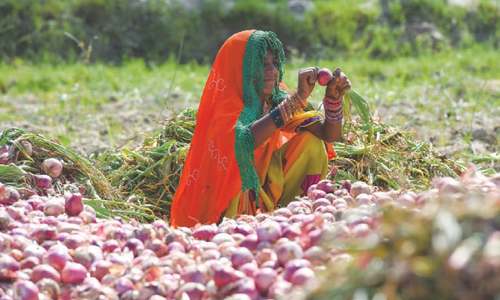
Apple, apricot, grape and dates are grown in specific zones due to suitable climate for quality fruit production, whereas onion, tomato, chillies and cauliflower are grown for markets of Balochistan and other parts of the country during off-season.
Being the principal cash earning commodities, fruits and vegetables are grown with mostly balanced supply of fertilisers combined with organic manures.
Sizeable numbers of farmers tend to apply fertilisers whereas the micro-nutrient application is not common in fruit orchards or even not practiced.
Traditionally, the vegetable growers in the province prefer organic sources because of its availability and low or no cost, according to the soil atlas.
Fertiliser offtake data for ten years (2008-17) in seven crop producing zones of Balochistan showed maximum annual urea offtake in five zones during eight years (2008-15) by two other crop zones.
Though DAP offtake in different crop producing zones during 2007-17 indicated maximum DAP offtake, consistent decrease in DAP offtake was recorded in the following years.
Speaking at the launching ceremony, USAID Deputy Mission Director, Clay Epperson, stated that the success of Pakistan’s agricultural sector will depend on the health and quality of the country’s soils. “Just as the soil gives to us, we must give to the soil,” he remarked.
FAO Representative in Pakistan, Mina Dowlatchahi, stated that the atlas is an important addition to the series of ‘Soil Fertility Atlases’ which will be instrumental in addressing the lack of data in managing soil fertility in Pakistan. Soil maps based on agro-ecological zones have been made part of the Balochistan atlas.
There is a need for raising awareness and increasing knowledge of farmers in addition to engaging with public and private sector to ensure sustainable agriculture development in Pakistan,” she said.
The launching of atlas marked the conclusion of the Soil Fertility Management for Sustainable Intensification Project, with soil atlases published in Punjab, Sindh and Balochistan provinces and a publication date of Dec 21 for Khyber Pakhtunkhwa.
Chief of National Fertiliser Development Centre of the Planning Commission, Abdul Jalil Marwat, also spoke on the occasion, and stated that declining land productivity with reduced crop yields has been one of the major problems being faced by our farmers.
Published in Dawn, December 11th, 2018