5
5

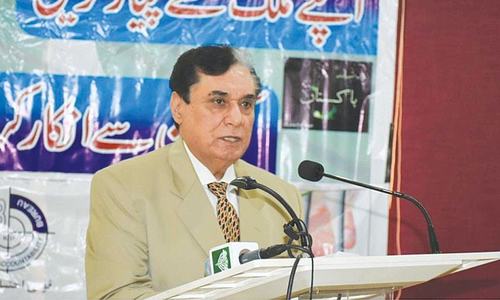
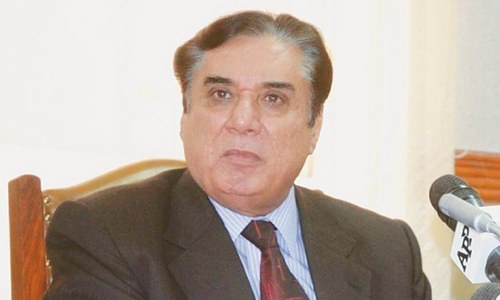
KARACHI: Chief Justice of Pakistan Mian Saqib Nisar has sent applications seeking recovery of missing persons to the Commission of Inquiry on Enforced Disappearances and called the record of applications submitted by the residents of the city’s Korangi area against a demolition drive.
The CJP heard the applications, which were moved by relatives of the missing persons and the Korangi residents against the demolition campaign being run by the Karachi Development Authority against illegal structures, in his chamber at the Supreme Court’s Karachi registry on Sunday.
Holding placards inscribed with their demands, men and women had earlier gathered outside the SC building against proposed demolition of their houses by the KDA and to seek recovery of their relatives allegedly picked up by law enforcement agencies.
The CJP directed his staff to receive the complaints and applications and place them before him in chamber along with the applicants.
Sympathising with the people, the CJP said he was aware about their problems. He then referred the matter to the Commission of Inquiry on Enforced Disappearances, assuring the applicants that the commission would make all-out efforts to recover their loved ones.
The residents of a Korangi locality complained that the KDA had served them notices to demolish their ‘illegal’ houses. The KDA officials said they were illegal because the plots had been curved out through China-cutting. The applicants maintained that if plots were created illegally then why the authorities concerned had leased them.
The CJP assured the applicants that he would not allow the authorities to raze the houses which were built in accordance with law. He said he was there to dispense justice. He restrained the KDA from demolishing the houses of the applicants and sought relevant record from the KDA, the board of revenue and other departments within a month.
Later in an informal talk with reporters, the chief justice said this time he found improvement in Karachi as far as cleaning and sanitation were concerned.
Commenting on criticism of a political party over his surprise visits to hospitals, the CJP said he had not visited the private hospital in Clifton but a sub-jail. The hospital room, where former information minister Sharjeel Memon was admitted in May for treatment, had been declared a sub-jail.
Vice president of the Supreme Court Bar Association (SCBA) Fareed Ahmed Dayo said he met the CJP in his chamber. He said they talked about prolonged power loadshedding in interior parts of the province. He said he also informed him about appointments of principals and board of governors at law colleges on a political basis in Sindh. He quoted the chief justice as saying that he would take up the issues during his next visit to Karachi.
Published in Dawn, September 3rd, 2018