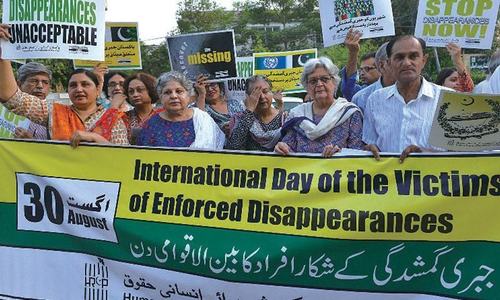
ISLAMABAD: A Supreme Court bench hearing the missing persons’ cases on Monday admitted that it was still groping in the dark as it had failed to make much headway.
The three-judge bench comprising Justice Ejaz Afzal Khan, Justice Maqbool Baqar and Justice Faisal Arab also asked the registrar of the Commission of Inquiry on Enforced Disappearances, Khalid Naseem, to submit a report about the “perceptible progress” made in locating the missing people.
The bench made the observation when Amina Masood Janjua — the chairperson of the Defence of Human Rights (DHR), an NGO struggling to trace the missing persons — said the commission had shut its doors to her NGO because documents relating to cases of missing people dispatched by it were being returned by post.
She also requested the court to order constitution of a fresh commission consisting of sitting judges of the superior courts so that the emotive issue of missing persons could be resolved within a stipulated period. “There is no let-up in the cases of missing people; in fact these are increasing by the day,” she remarked.
Commission of Inquiry on Enforced Disappearances says it has disposed of 3,000 cases while 1,577 are still pending
Later, in a statement released to the media, Ms Janjua claimed that the commission had been instructed not to entertain the cases dispatched to it by her NGO. She also requested the court to give the task of resolving the old issue to the interior ministry.
However, the bench explained that it did not have the authority to do so or to even order the formation of a new commission. Only the chief justice enjoyed the requisite authority.
Though the bench assured Ms Janjua it would continue to hear the cases of the missing persons, it regretted that not only did the administration fail to find the persons involved in their enforced disappearance but the affected families also did not have concrete material that could enable the court to move in the right direction.
Ms Janjua said that most of the affected families were poor and did not have the means to bear the cost of appearing in the courts or before the commission every now and then. As a result, they relied on DHR for which everything had to be managed and arranged by her despite her meagre resources.
The court asked the federal government to consider providing subsistence allowance to the parents of those who had long been missing after consulting the matter with secretary of the interior ministry.
Deputy Attorney General Sajid Ilyas Bhatti recalled how a policy was formulated in 2011 to take care of a group of people by providing a subsistence allowance to them. But he said the allowance was only meant for people affected by terrorism.
At this the court observed that prima facie the victims of enforced disappearances were victims of terrorism and deserved subsistence. It asked the deputy attorney general to apprise the court at the next hearing of the possibility of provision of an allowance to the affected people after consulting the matter with the secretary concerned.
Justice Khan regretted that old parents of the missing people were facing all kinds of problems as they could not look after themselves due to their advancing ages.
During the proceedings retired colonel Inamur Rahim — a lawyer known for pleading the cases of the missing persons— regretted that the commission concerned had disposed of cases on the basis of reports filed by intelligence agencies and claimed that individuals facing trials in military courts were not being provided legal counsel to defend them. At this the court assured the counsel that it would look into the matter provided he brought even one such example before it.
When the court was told that Ibadur Rehman (one of the persons whose cases were pending before the court) had fled to Afghanistan, Justice Khan regretted that what happened in Afghanistan had not just left damaging effects on Pakistan’s economy but also its social fabric, adding that the Pakistani government was also responsible for the debacle.
The secretary of the Commission of Inquiry on Enforced Disappearances told the court that it had disposed of 3,000 cases while 1,577 were still pending with it.
Published in Dawn, February 27th, 2018