4
4

LET us first acknowledge the good among us. For the first time in the history of this country, we are moving towards a genuine culture of accountability that includes the mighty and the powerful. There can be nothing more exhilarating than to see a sitting prime minister being subjected to an investigation before a joint investigation committee set up by the Supreme Court of Pakistan.
We hope that the acclaimed precept that nobody is above the law is now firmly embedded in our national life. Credit is due, and must be noted, to the consistent and stubborn leadership on this issue by the nascent star on Pakistan’s political horizon.
But, however laudable the accomplishment of accountability is, it is through a process that is flawed. And that is the bad news.
The basic wrongness of the process is that it is being done under Article 184(3) of the Constitution. There is no appeal that is allowed in a result under Article 184(3). On that ground alone, the process is violative of the recently added fundamental right to a fair trial enshrined in Article 10A.
Transparency, propriety and decorum anchor a fair trial.
As plainly understood, there cannot be a fair trial in a matter in which any aggrieved party does not have a right of appeal/review. We are supported in this conclusion by the overwhelming corpus of national and international jurisprudence that includes a right of appeal as an essential element/component of a fair trial.
The 1966 UN International Covenant on Civil and Political Rights that developed the declaratory content of the 1948 Universal Declaration of Human Rights into binding legal obligations provides the right of fair trial as including the right of appeal/review [Article 14(5)]. Although this article relates to criminal offences, its principles have resonated to all trials.
Over an 18 years preparatory process at the United Nations, countries from all over the world and representing all the principal legal systems — Chinese, Japanese, European, American, Inter-American, Asian, Australian, African — looked to the common denominator — many times lowest — of these systems to develop the minimum standards of human rights and the rule of law as part of the International Covenant.
The result is that it is not acceptable to hold out the right to a fair trial without providing for a right of appeal. Article 184(3) of the Constitution does not meet the requirements of a fair trial as added in Article 10A. Attempts were initiated many years ago to provide an appeal, within the Supreme Court, under Article 184(3) but this has recently been politicised. Such a right of appeal would expand on the right of review, within the Supreme Court, already available in some cases before the Supreme Court.
Regional human rights treaty regimes such as the European Convention on Human Rights, 1950, the Inter-American Convention of Human Rights, 1969, the African Charter on Human and People’s Rights, 1981 and the Arab Charter on Human Rights, 2004, some with an extensive jurisprudence by their courts and commissions, support the International Covenant on Civil and Political Rights.
The process under way in Pakistan also appears flawed because of the non-observance of judicial propriety and judicial decorum in the proceedings. When both these are absent in a judicial system or not observed, it vitiates the fairness of a trial.
Justice should not only be done but seen to be done. Transparency, propriety and decorum anchor a fair trial.
Propriety is alleged to be lacking when judges do not recuse themselves or disclose a conflict of interest. The practices of courts all over the world, including our own, are replete with examples when judges recuse themselves from cases in which they had earlier acted in a professional or a personal relationship.
This practice was not followed to the repeated disclosure of such conflict of interest by the parties on trial. Case law may be cited to support this but there is available a more robust jurisprudence that points to the elements of transparency and stricter reliance on the conflict of interest ethics. Justice, I believe, is better served with the more prudent choice.
Judicial decorum enhances the majesty of the law but when indecorous remarks as ‘mafia’, ‘throw them out of the window’, ‘trash them in the dustbin’, ‘chacha mamas’, ‘paper good only for selling pakoras’ are made, it lowers the pedestal of justice and undermines the basic requirements of a fair trial.
Finally, the allegations of trying to force the choice of members of the JIT through non-transparent methods such as WhatsApp repeatedly discussed on news channels and newspapers have not been satisfactorily answered. Nor the inclusion of certain members of the JIT who were allegedly biased and conflicted.
Accountability, yes. Without a fair trial, no.
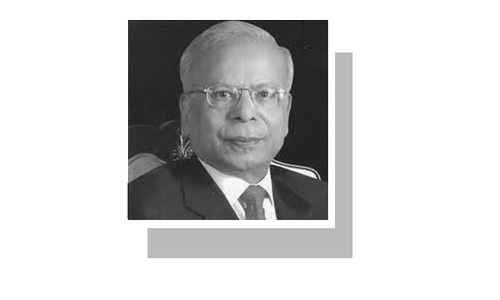
The writer is senior advocate of the Supreme Court of Pakistan. This article is based on his observations at a Pildat meeting.
Published in Dawn, July 6th, 2017