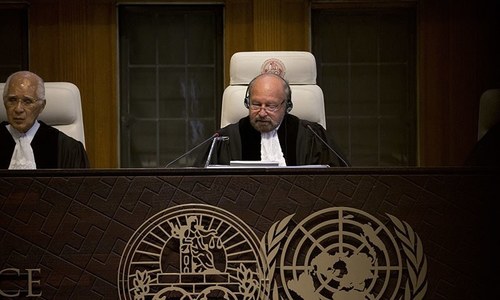
NEW DELHI: There is a bit of history to the hyped fight between two legal experts — Harish Salve for India and Khawar Qureshi for Pakistan — in the International Court of Justice (ICJ), which is seized with the Kulbhushan Jadhav case.
At the moment Salve seems to have the upper hand in the case, with the ICJ staying Jadhav’s possible execution until a final judgement on the matter.
More than 15 years ago, there was a curious turn of events when India was forced to face arbitration at an international tribunal in the US initiated by Enron over the closure of the Dabhol power project. Millions of dollars were at stake for India. Salve, who had quit as solicitor general of India in November 2002, was retained as India’s counsel at the arbitration tribunal.
In 2004, the UPA government came to power as also a new team of law officers headed by attorney general Milon Banerjee. To manage the high-stakes arbitration over Dabhol against Enron, the government chose the Fox and Mandal law firm.
Government sources said Salve was sounded out whether he would continue as India’s counsel in the arbitration proceedings. Salve confirmed and informed the new government that he would continue to charge a concessional fee of Rs100,000 for a day’s hearing in the US-based tribunal.
Read more: ICJ stays Jadhav's execution, says it has jurisdiction in case brought by India
However, there was a sudden change of heart and the Fox and Mandal firm was asked to hire Khawar Qureshi. India ultimately lost on both counts, the case to Enron and a lot of money that was paid to Qureshi as fees.
Salve confirmed to the Times of India that he had agreed to fight the case for India in the tribunal despite change of government. “It was a professional decision to defend India in the tribunal. But, I learnt from media reports later that Qureshi was hired and I could become his deputy.... So I decided to keep away, wishing India the best.” Salve refused to divulge any more details of how he was replaced by Qureshi in 2004.
Explore: Experts wonder why ICJ jurisdiction was recognised in March
An article from 2004 in The Lawyer, states that Serle Court chambers’ lawyer Qureshi had been appointed as counsel for the government of India. A host of UK firms had been invited to take India’s case.
A spokesperson for the previous law firm had said: “Following the appointment of the new attorney general, the entire legal team... was replaced.”
By arrangement with the Times of India
Published in Dawn, May 22nd, 2017