0
0
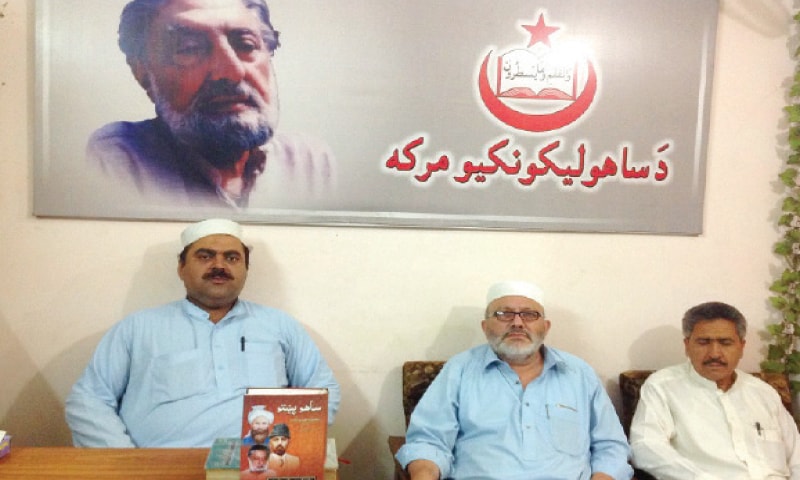

PESHAWAR: A Pashto book titled ‘Sahu Pukhto’ (untainted Pashto) was launched here on Monday.
A literary organisation, Qalandar Momand Research Cell, organised the event at its offices in Hashtnagari area here, where members of Da Sahu Leekunkeo Maraka, a literary organisation, senior writers, poets and young researchers were in attendance.
The speakers said they hoped that the book would address issues relating to Pashto script and help pave the way for adopting a unified Pashto script for written expression.
They stressed the need for a unified Pashto script towards better understanding, preservation of literary treasure trove and improved communication.
The speakers said Sufi saint Bayazid Ansari was the first to evolve shapes for specific sounds of Pashto in his celebrated book ‘Khairul Bayan’ some 460 years ago.
They regretted many other writers continued making changes to Pashto script but failed to draft a unified script.
The speakers said the number of Pashto script letters was 44 so scholars should make it easier for common Pakhtuns to read and write Pashto text.
The DSLM was founded by prominent progressive Pashto poet, critic and linguist Qalandar Momand.
After the death of Qalandar Momand in 2003, his followers not only carried on his legacy of his literary tradition but also founded the QRC, which kept on bringing out research works on self-sponsored basis. The new 688-page book on Pashto script is sixth in line.
The speakers said the new book written along scientific lines would resolve longstanding issues existing among different literary school of thoughts regarding Pashto script writing.
They said currently, several scripts were in practice causing great difficulties and confusion for common Pakhtun readers. The speakers regretted that despite elapse of more than four centuries, Pakhtun literati could not evolve and agree on a unified written script.
“Pashto script has still issues, which need immediate attention of linguists and research scholars. Bara Gali Pashto script seminar held under the auspices of Pashto academy, university in 1990 could not address all issues of a unified Pashto script, also decisions taken unanimously in the seminar, were also not fully implemented,” a speaker said.
Mushtaq Majrooh, author of the book, said Qalandar Momand, a noted critic and linguist, on several occasions tried his best to convince Pakhtun literati on his own version of Pashto script based on his scientific arguments and scholastic knowledge.
“Unfortunately, a unified script cannot be popularised. The result is that we today have several scripts being followed by Pakhtun folk. Most young Pakhtuns use either Roman script for Pashto or their self-styled script on social media,” he said.
Zalan Momand, a young scholar, said the book under discussion was in fact crux of his hard work spread over three decades.
He said despite covering a complex topic, the book was a masterpiece of fluent expression.
Rokhan Yousafzai said the book was a precious research document and therefore, it should be included in the syllabi of universities.
Published in Dawn October 25th, 2016