PM to unveil austerity plan today to cope with war fallout

• Premier stresses ‘sensible use’ of petroleum products during Iran crisis; says burden should be borne ‘judiciously’ by all segments of society
• Three fuel shipments expected today, petroleum minister tells Sindh CM; predicts LNG supply disruptions
• Finance minister warns monthly oil import bill could rise to $600 million
• Punjab CM calls for uninterrupted diesel supply for agricultural use
ISLAMABAD / LAHORE: Prime Minister Shehbaz Sharif is expected to unveil an austerity plan today (Monday) in view of the global fuel crisis, triggered by the US-Israel war on Iran, and the subsequent attacks on oil-producing Gulf states.
Last week, the government increased the prices of petrol and high-speed diesel by Rs55 per litre, the highest-ever such hike, as the country felt the first direct economic impacts of the ongoing regional conflict.
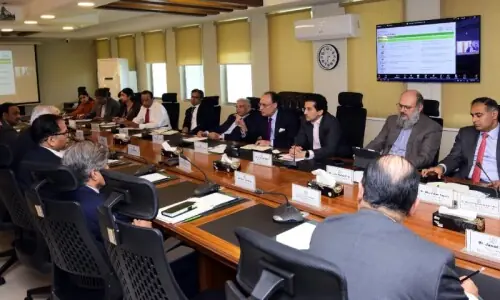
According to the Prime Minister’s Office, the premier chaired a meeting on Sunday to review the government’s austerity strategy, amid the prevailing situation in the Middle East.
The meeting was informed that the final plan regarding austerity and savings would be announced on Monday, a press release said.
Participants were told that the country had adequate reserves of petrol and diesel. They were further informed that the government had already taken precautionary measures to deal with any situation.
The government has already prepared a contingency plan under which work from home and distance learning have been proposed until the situation returns to normal. However, the prime minister deferred the plan on Friday and decided to review the situation on a weekly basis. Presiding over the meeting on Sunday, PM Shehbaz stressed the need for the sensible use of petroleum products during the ongoing crisis.
He said the burden of austerity should be borne judiciously by all segments of society, while the elite and privileged class should set an example by adopting “adjustments” and “austerity measures”.
The prime minister urged federal and provincial ministers and government officials to play their role in providing relief to the public as well as the available resources.
He said that in view of the prevailing international situation, immediate precautionary measures were necessary to avoid a further crisis. “The government is fully aware of the situation and fluctuations in international oil prices, and therefore measures are being taken to provide maximum relief to the people,” he added.
The meeting was attended by Deputy Prime Minister Ishaq Dar, Finance Minister Muhammad Aurangzeb, Planning Minister Ahsan Iqbal, Power Minister Awais Leghari, Petroleum Minister Ali Pervaiz Malik, Information Minister Attaullah Tarar, the prime minister’s special assistant Haroon Akhtar Khan and the chief secretaries of the four provinces.
Shipments arriving
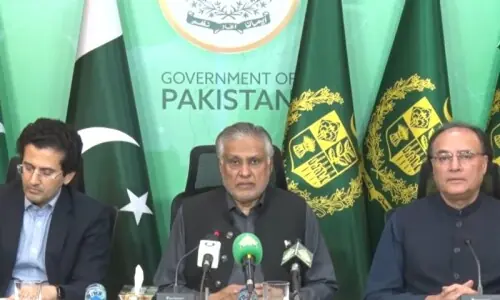
Meanwhile, three petroleum shipments are expected to reach Pakistan by today (Monday), Petroleum Minister Ali Pervaiz Malik informed a briefing on Sunday in Karachi held to discuss rising global oil prices and fuel reserves amid conflict in Middle East.
The petroleum minister and Finance Minister Muhammad Aurangzeb held separate meetings with Sindh Chief Minister Murad Ali Shah and Punjab Chief Minister Maryam Nawaz in Karachi and Lahore, respectively, a day after the prime minister directed them to work with provincial governments on a strategy to conserve fuel and ensure uninterrupted supply of petroleum products amid shortage concerns triggered by the Israel-Iran conflict.
During the meeting in Karachi, the federal government delegation gave a detailed briefing to the Sindh CM on the recent price hike and the status of fuel reserves.
Mr Aurangzeb told participants that the country’s monthly oil import bill could increase to $600 million in the backdrop of the conflict. He added that the government was closely monitoring global energy markets and preparing alternative plans to deal with the financial impact.
Additionally, crude prices could rise to $120 a barrel if the conflict escalates further.
The delegation said diplomatic contacts were underway with Saudi Arabia, Oman and the UAE for alternative fuel supplies, while efforts were also ongoing to ensure supply routes other than the Hormuz. “LNG supply disruptions are also expected because of Qatar declaring force majeure,” the petroleum minister said.
He stressed that fuel-saving measures were necessary so that existing reserves could last longer, adding that Pakistan would request the IMF for relief in the petroleum levy.
The federal and provincial governments agreed to enhance coordination to prevent hoarding at petrol pumps, with the finance minister briefing participants about a joint dashboard being prepared to monitor fuel reserves.
Sindh CM Murad Ali Shah said the proposals discussed in the meeting would be presented to the provincial cabinet for consideration.
‘Must show resilience’
Similarly, Mr Malik and Mr Aurangzeb also met Punjab Chief Minister Maryam Nawaz in Lahore to review the situation arising from the war and its possible impact on petroleum supplies.
Participants reviewed the available reserves of petroleum products in Punjab and discussed measures to maintain a balance between demand and supply.
The meeting agreed to adopt a fuel conservation policy to maintain equilibrium in petroleum demand and supply. The CM emphasised the need to ensure uninterrupted availability of diesel for agricultural use.
CM Maryam directed the district administration to continuously monitor petroleum supplies and ordered a strict crackdown on hoarding.
She also instructed the Punjab Enforcement and Regulatory Authority and the Transport Department to closely monitor the situation and take action where necessary. The chief minister said the public should not have to stand in long queues at petrol pumps and directed that the sale of petroleum products above officially notified prices would not be allowed anywhere.
She said the nation must demonstrate resilience to face emerging challenges, adding that timely decisions were essential to safeguard economic stability.
Published in Dawn, March 9th, 2026