0
0
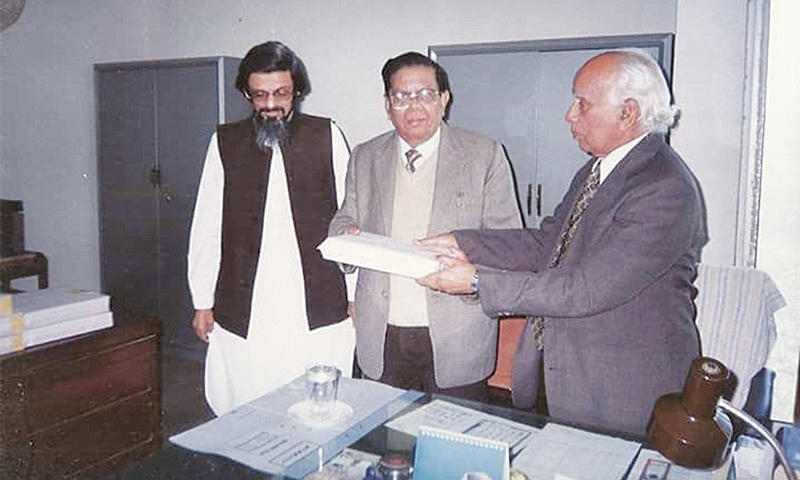
RENOWNED Indian scholar of Urdu Dr Khaliq Anjum passed away on Oct 18, 2016 in Delhi. He was buried in Delhi’s Jamia Millia Islamia graveyard — and with him was buried a part of Delhi’s history, too.
Khaliq Anjum was a teacher, researcher and translator, who not only edited, wrote, translated and compiled some rare and important books, but also relentlessly worked for promotion of Urdu and its survival in India. Among his over 70 books, the ones on Delhi’s relics, Ghalib’s letters and textual criticism made him a well-known name in the Urdu’s literary circles the world over.
Khaliq Anjum was known for his tremendous research work on — and profound knowledge of — Delhi’s history, culture and its archeological sites. In addition to his scholarly work, he practically fought for decades for the restoration of some of Delhi’s historical sites, out of his sheer love for Delhi’s history and its relics.
Ghalib and Zauq’s tombs in Delhi were in a shambles and it was Khaliq Anjum who fought for their restoration for years. Shahid Mahali in his article included in the special issue of Aiwan-i-Urdu, titled ‘Khaliq Anjum: kaseer-ul-jihaat shakhsiyet’, has described it in detail (pages 202-213). Published from Delhi in 2000, the magazine’s issue was compiled by Anis Dehlvi and is available online (www.rekhta.org). According to Mahali, Ghalib’s tomb was surrounded by huts and the vicinity was ruled by drug pushers. Khaliq Anjum strived for years to get it cleared and maintained. On the piece of land where once stood Zauq’s grave, the Delhi Municipal Corporation had built public latrines. Khaliq Anjum discovered Zauq’s grave and went into litigation for its restoration.
He appeared like a lawyer before the Supreme Court, with the permission of the court, to explain the historical facts. Ultimately, after a long-drawn legal battle, the court ordered demolition of latrines and construction of Zauq’s tomb. The reports on hearings and verdicts were reported in many Indian newspapers, too, and the documents are preserved at Delhi’s Anjuman Taraqqi-i-Urdu Hind (ATUH).
When the Gujral Committee on Urdu was formed by then Indian prime minister Indira Gandhi, it was headed by Inder Kumar Gujral, who later on became the prime minister of India. Dr Khaliq Anjum was appointed the committee’s director. As director, Dr Anjum travelled extensively in India, gathering facts, and submitted a report, giving some invaluable suggestions for the promotion of Urdu in India. While the report was consigned to cold storage for political reasons as some cabinet ministers were not in favour of implementing its recommendations, just one suggestion was effectively accepted. It was about establishing academies for promotion of Urdu in all Indian provinces where Urdu was spoken widely. But only 13 Indian provinces got such academies and they are still working, publishing a large number of Urdu books every year for the last 40 years or so.
The ATUH was in a real bad shape when Khaliq Anjum was made its secretary. He soon turned it around and got ‘Urdu Ghar’, a multi-storey building, constructed for it. He established some 600 branches of Anjuman all over India. Doordarshan began telecasting Urdu news after a long struggle and Dr Anjum fought for it on behalf of lovers of Urdu. Along with Prof Abdul Mughni, Dr Anjum played a pivotal role in getting Urdu declared as the second official language of Indian province of Bihar.
Khaliq Anjum was born in Delhi. The book jointly compiled by Gopi Chand Narang and Abdul Latif A’azmi has mentioned Jan 22, 1933, as Khaliq Anjum’s date of birth. But Malik Ram and some other scholars think that Dr Khaliq Anjum was born on Dec 22, 1935.
Dr Anjum’s paternal grandfather came from Rampur and settled in Delhi. Dr Anjum was brought up and got his early schooling in Delhi. This must have made him a true “dilli wala’ as many of his research works and his knowledge about Delhi’s history and archeological places show.
Khaliq Anjum did his graduation from Aligarh Muslim University and MA and PhD in Urdu from Delhi University. He taught Urdu at Delhi’s Karori Mal College for about 10 years and then joined the ministry of education. After joining the ATUH, he edited Anjuman’s quarterly Urdu adab and fortnightly Hamari zaban for quite a long time.
Some of the books he wrote or edited are: Ghalib ke khutoot , Matni tanqeed, Mirza Rafi Sauda, Ghalib aur shahan-i-Taimuriya, Dehli ke aasaar-i-qadeema, Dilli ki dargah shah-i-mardaan, Hasarat Mohani, Asif Ali aur Aruna Asif Ali, Aasaar-us-sanadeed (by Sir Syed Ahmed Khan)’, Moulvi Abdul Haq: lisani aur adabi khidmaat, Seerat-i-Fareediya (by Sir Syed), Muraqqa-i-Dehli, Fan-i-tarjuma nigari, Meraaj-ul-a’ashiqeen and Mirza Mazhar Jaan-i-Janan ke Farsi khutoot.
We have lost a scholar who loved Urdu, Delhi and Delhi’s culture and devoted his life to fight for that cause.
Published in Dawn, October 24th, 2016