NEW DELHI: India has decided to suspend Indus Water Commission talks until “Pakistan-sponsored terror” in India ends, The Hindu said on Monday.
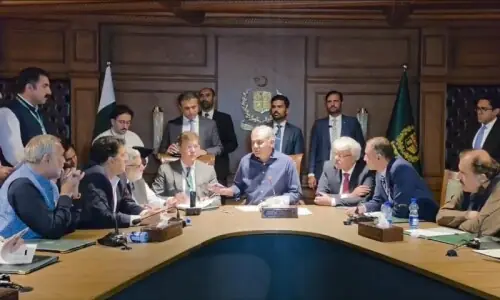
It quoted sources as saying the decision was taken at a meeting presided over by Prime Minister Narendra Modi on Monday to review the Indus Waters Treaty (IWT) with Pakistan amid heightened tension between the two countries.
National Security Adviser Ajit Doval, Foreign Secretary S. Jaishankar, the water resources secretary and senior officials were present at the meeting, the paper said.
According to a former commissioner for the IWT, India’s decision to suspend talks on the treaty means that there will be no meetings, as described in the agreement, between the commissioners of the two countries in future. “If they (India) have decided to do so, there will be no meeting between the commissioners of the two countries that is mandatory to be held once in a year. Similarly, the meetings that are held time to time under the treaty on any issue either on the request of Pakistan or India will not be held now,” Syed Jamat Ali Shah told Dawn.
Sources told The Hindu that while the treaty was not reviewed in the meeting, steps to utilise India’s western rivers in a better way were discussed.
It was also decided to suspend the 1987 Tulbul navigation project and review it. Mr Modi was briefed about the dams under construction in Jammu and Kashmir, who wanted work on them to be expedited.
Mr Modi said that “blood and water can’t flow together”.
The review is being undertaken as India weighs options to respond to Pakistan following the Uri attack that left 18 soldiers dead.
There have been previous calls in India that the government scrap the water distribution pact to mount pressure on Pakistan in the aftermath of earlier terror attacks.
Under the treaty, which was signed by Prime Minister Jawaharlal Nehru and President Ayub Khan in Sept 1960, water of six rivers — Beas, Ravi, Sutlej, Indus, Chenab and Jhelum — are to be shared between the two countries.
Pakistan has been complaining of not receiving enough water and gone for international arbitration in a couple of cases.
Khalid Hasnain in Lahore contributed to this report
Published in Dawn, September 27th, 2016