0
0
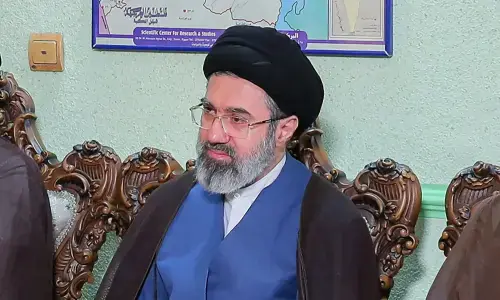
KARACHI: More than sixty per cent people in Balochistan live a nomadic life, while others are settled in cities. The religious symbolism as a result of the architecture used in the province is simple and used to convey a simple meaning and emotion, said visual artist and critic Dr Mohsen Keiany during a lecture at Koel Gallery on Wednesday.
A resident of Shiraz, Iran, Dr Keiany spoke about the living traditions of Balochistan that largely circle around the nomadic life. His observations, which also became part of the book he wrote as a result of visiting the province over a number of years, speak of cultural traditions which form religious symbolism representing how a community thinks and lives.
The book, Balochistan: architecture, craft and religious symbolism, looks into how symbols originate and form part of a larger cultural context.
In his presentation, Dr Keiany spoke about the various invasions in the region. Invaded by many outsiders over the centuries be it the Macedonians, as part of Alexander’s conquests, Persians, Arabs and Afghans, to the Mughals and then the British which finally made it a link between what later became Pakistan and the trans-Asia routes. “As a result of those invasions, there are similarities between the black encampments used by the nomads in Balochistan with that of the encampment used by the Arab Bedouin,” he said.
While discussing the tents, he pointed out the variations in the style of the hoops used to put up a tent. Earlier, nomads used animal hides by hanging them over large bones to shield themselves which later turned into a black tent — a trend that can be witnessed throughout Asia and the Middle East.
The nomadic mosques are basically marked by stones especially around the rural areas on main Quetta-Chaman Road. “These stones mark the mehraab and the minaret, while for an outsider, it won’t make much of a difference. I remember stepping inside one such mosque for which they questioned my faith, saying that if you were a Muslim, you would know this is a mosque,” he said amid laughter from the audience listening to him. Sharing some pictures of similar mosques that he saw during his travels inside the province, he stopped at one particular picture of a stone-mosque in Dalbandin, which was observed by Henry Landor in the late 19th century and spoke about the form and shape that continued for centuries.
He said the word Baluch was first used in Persian poet Ferdowsi’s Shahnameh while speaking about the two tribes of a nation of warriors known as Kuch and Baluch.
Being Pakistan’s largest province, Balochistan is mostly misunderstood by outsiders, said Dr Keiany. “I live in Shiraz and whenever I said to someone that I wanted to visit Balochistan I was told that it was too dangerous and risky to visit. But I didn’t find it dangerous. I found the people nice and observed that once they like you enough to trust you, they trust you and defend you till the end,” he added.
Published in Dawn, February 4th, 2016