7
7
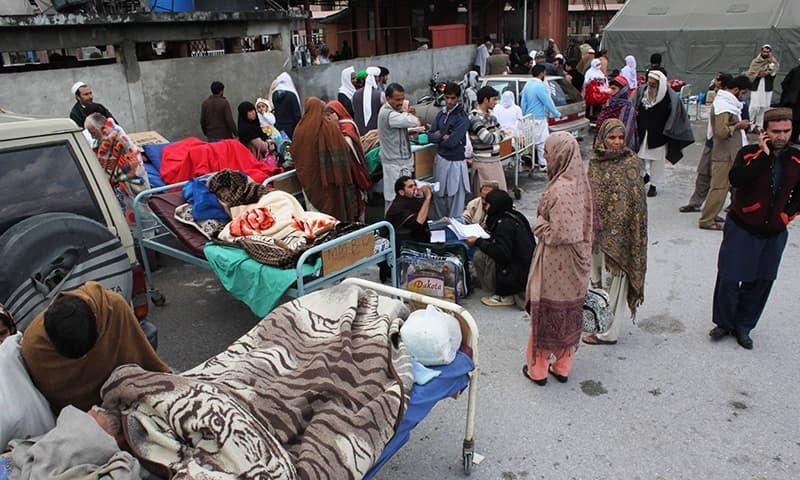
AS the dust from Monday’s earthquake begins to settle, the death toll has been rising and the wounded continue to trickle in from remote areas of Khyber Pakhtunkhwa.
Thus far the governments at the centre and in KP have done a commendable job of keeping themselves focused on the response to the disaster, and the prime minister’s intention behind visiting the affected areas, particularly with the KP chief minister accompanying him, makes for all the right optics.
The announcement of a relief package is also timely and the professed intent to coordinate with the KP government before finalising it is also praiseworthy.
Also read: Pakistan in the most active quake zone, says US Geological Survey
The lead role to be played by the National Disaster Management Authority in coordinating the damage assessment is important.
It is heartening to see that here too coordination failures with the provincial disaster management authorities do not appear to be turning into a sticking point as they have in the aftermath of past calamities.
But the continuing arrival of wounded people from remote locations to Peshawar is worth a second look. Large parts of Pakistan’s topography are mountainous, and the habitations in these areas are vulnerable to even the mildest of shocks, whether seismic or climatic.
In some measure, this is dictated by facts on the ground: habitations in these areas are small and scattered widely, and distance poses a formidable barrier given the terrain. Roads are in poor condition; infrastructure and service delivery are barely present.
Yet, these communities bear the brunt of the natural disasters striking Pakistan in recent years, from the 2005 earthquake, to the floods of 2010, to the most recent glacial lake-driven flooding in Chitral in July. And now the earthquake too has hit Chitral harder than any other place; in fact, the majority of the almost 4,000 homes reportedly destroyed are in Chitral.
The work thus far has been decent, but two areas clearly need attention to strengthen the response next time.
One is greater attention to the habitations in the mountains, where deficient access and infrastructure as well as the poor quality of services serve as strong drivers of vulnerability. The other is clearer SOPs in dealing with a natural disaster in real time.
The lesson here is the strong vulnerability of mountain communities, which are considerable in number, as well as the lack of an SOP to determine when a state of disaster exists and who takes over at that point to coordinate the response, and what tools will be made available to that lead agency.
Once the crisis stage is over and the wounded are treated and the departed have been laid to rest, it would be a good idea for the government to work on these priorities to ensure that next time, should the scale be larger, the authorities are not overwhelmed.
Published in Dawn, October 28th, 2015
On a mobile phone? Get the Dawn Mobile App: Apple Store | Google Play