0
0

KARACHI, Oct 22: Various soft drinks under the name of Mecca Cola, Zamzama Cola, Amrit Cola, Zam Zam Cola, Al-Mecca Cola, etc., have now hit the market as an alternative option for the consumers who are not interested in drinking American brand soft drinks.
The new players are offering soft drinks at Rs25-30 for a 1.5 litre bottle as compared to Rs35 offered by old players. After smelling the competition, the local producers of Coca Cola and Pepsi had to reduce their prices under a discount scheme of Rs5 to 10 on 1.5 litre bottle in order to maintain their market share.
However, confusion has totally gripped the market, sparking doubts about the originality, taste, quality and fake addresses of new colas.
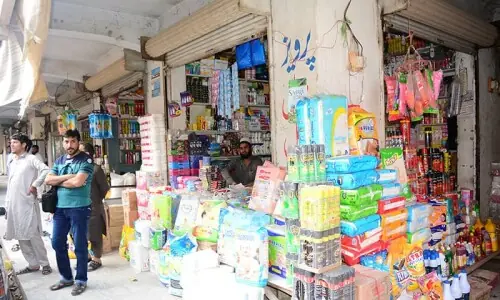
Many shopkeepers, interviewed by Dawn, appear totally ignorant about the whereabouts of any factory or bottling plants of these new entrants. They plainly refuse to give details, saying that a distributor comes and sells its product.
Under such circumstances, many shopkeepers are also selling fake cola specially Mecca Cola. Shopkeepers, in connivance with the distributor, are claiming their originality, but actually they are cheating the consumers who buy these products for being cheap as compared to Pepsi and Coca Cola.
Many shopkeepers, approached by Dawn, are also avoiding to give the name of the distribution company. They are not ready to reveal anything.
“Distributors come after a week or fortnightly and we buy these new colas,” a shopkeeper said.
On the other hand, many new cola makers have given fake addresses of factories, websites besides not printing any phone numbers on the bottle label. Many bottlers have printed the details of cola in Arabic language. Some bottles do not carry expiry date of the product as well as contents of ingredients. Ordinary vans, carrying no company logo on it, are distributing their products in the markets. Even distributors of fake colas do not wear company’s uniform besides not carrying visiting cards for their identity. There are also reports that some new entrants are filling the water in old bottles as the bottles do not look clean.
It is an irony that price-conscious consumers, are opting for these products without realizing that the product may prove harmful for their health. Even shopkeepers, despite knowing the stark realities, are equally involved in this game of befooling the consumers.
The fact that these products were launched without marketing campaign shows that many colas, selling in the markets, are fake and are evading taxes and duties. It is hard to set up an organised soft drink industry on the pattern of old players as organized sector has to pay 12 per cent excise duty and 15 per cent sales besides other taxes and duties.
Under these circumstances, genuine new players are now facing problems as some unscrupulous elements have already launched their brand name prior to launching of the original brand.
A distributor of Mecca Cola told Dawn from Islamabad that the company is concerned over the availability of fake cola under the name of their product. The company has already flashed an advertisement in a leading newspaper just to give the clear picture of original soft drink product and caution the public to avoid purchasing fake drinks.
He said the company has already introduced the new product in Pindi, Lahore and Islamabad where public response is very positive. The company will officially role out the Mecca Cola in the first week of Ramazan, and currently it is being sold on trial basis in various cities.
“The new company aims to capture five to seven per cent market share, which would gradually be increased,” he said.
Mecca Cola chief executive, Tawfiq Mathlouthi in a visit to Pakistan in September said that Pakistan would become the 48th country in the world to have this ‘halal drink’ which is a symbol of resistance against globalization.
Mecca Cola, a competitor of two US cola products, is enjoying a five per cent market share in 47 countries of Europe, Middle East and the South East Asia. Proprietors claim that around 20 per cent proceeds of the Mecca Cola sales would go to the charity working for the welfare of Muslims in different parts of the world. He said that the Mecca Cola with equally good taste and halal contents, would be available to the Pakistanis at a comparable price.
Sales Manager, Zam Zam Cola, Rehan Zahid said that the company has launched its product in July this year. “We are currently distributing the product after importing from Iran and we are starting its production shortly,” he told Dawn on Wednesday.
Zam Zam is currently available in 1.5 litre and non-refundable bottle of Rs35 and Rs15 respectively. He claimed that his Iranian product has captured four to five per cent market share in 1.5 litre and two per cent in disposable categories.
Meanwhile, a distributor of Zamzama Cola avoided to give the telephone number of company’s executives. There is no telephone number on the bottle. However, there is a website number but the site does not open.
On condition of anonymity, he said the company has 10 distribution centres. “I distribute around 200-300 crates (six big bottle in each crate) in my jurisdiction and the consumer response towards our product is good.”
He claimed that the new entrants including his product has captured around 25-30 per cent market share. The product is also being distributed in the interior Sindh.
Shopkeepers said that some consumers do not buy the new colas after tasting first time and usually complain about the taste when compared to Pepsi and Coca Cola. While some shopkeepers say that some products, if original, have a good taste and people do come to buy for the second time.
Replying to a question regarding marketing strategy of new products a shopkeeper termed it to be weak as compared to organised players.
When contacted old players say they do not feel threatened by new entrants in the field. “I do not think that these various brands of cola will be able to carve a major share in the Pakistani market,” Chairman Pakistan Beverage Manufacturers Association (PBMA), Siraj Kassam Teli told Dawn.
“I think that their share in Karachi is hardly one per cent. However, they enjoy two to four per cent share in the upcountry like Peshawar, Rawalpindi, Lahore and Islamabad,” he said.
Siraj, a director in Pakistan Beverage Limited (PBL), makers of Pepsi Cola, said that his company enjoys 65 per cent market share followed by 30 per cent by the Coca Cola, while the rest is enjoyed by these new cola companies.
There is virtually no serious impact made by these new players in the market. “I am sure that their share will remain pegged at five per cent,” he added.
The annual total sales of two leading players range between 175-180 million crates and every year the organised players are gaining their sales by eight to 10 per cent, he claimed.
“We are satisfied that the share and sales growth of old players will remain intact in future as the population is rising and so the consumer confidence on our product,” Siraj said.
Many new entrants have entered the market with a new concept of Islamic Mashroob or Halal Drink. “No problem. Everybody knows that the food products, marketed by foreign companies in Pakistan, are made of halal contents. If there was any problem, consumers would have rejected them much earlier,” PBMA chief said.
The beverage industry has been contributing over Rs6.5 billion annually to the national kitty in the form of sales tax and excise duty only and providing jobs to over 500,000 persons.
The industry, he said, is also facing double taxation problem by paying central excise duty (CED) and sales tax on the same product. The government had agreed that the excise duty would be abolished over a period of five years which has started last year by reducing it to 12 per cent from 15 per cent. However, he said in this budget the government did not fulfil its commitment by abolishing the excise duty by three per cent.