0
0
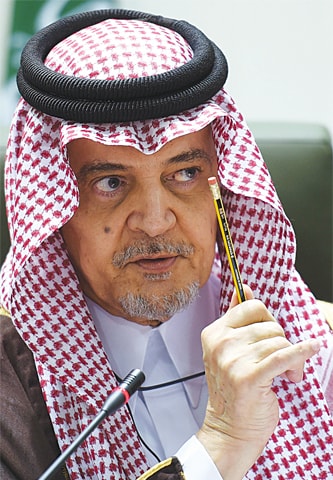 |
| Prince Saud al-Faisal.—AFP |
RIYADH: Former Saudi foreign minister Prince Saud al-Faisal died on Thursday, Saudi Arabian sources and media close to the kingdom’s ruling family reported, two months after he was replaced following 40 years in the job.
Prince Saud, who was 75, was the world’s longest serving foreign minister when replaced on April 29 by Adel al-Jubeir, the then-ambassador to Washington.
The Al-Arabiya channel, which is close to King Salman’s branch of the ruling family, confirmed the news.
Prince Saud retained an influential position in Saudi foreign policy circles even after his replacement, serving as an official adviser to King Salman, who took power in January, and was sometimes present when foreign leaders met the monarch.
Even before the 2011 Arab Spring, when Saudi Arabia faced unprecedented regional tumult, Prince Saud was a significant player in Middle East diplomacy, a landscape that had changed radically since October 1975 when he was appointed as minister.
Egypt and Israel had not yet made peace, Yasser Arafat led the Palestine Liberation Organisation from shell-pocked refugee camps in Lebanon, Iran’s Shah ruled from his Peacock Throne and, in Iraq, a young Saddam Hussein was plotting his path to power.
Prince Saud’s tenure covered Israeli invasions of Lebanon in 1978, 1982 and 2006, the Palestinian intifadas that erupted in 1987 and 2000, Iraq’s invasion of Iran in 1980 and Kuwait in 1990, and a US-led coalition’s occupation of Iraq in 2003.
Equally at home in Arab robes or a tweed suit and tie, and as fluent in English as in Arabic, Prince Saud proved adept at cutting through diplomatic niceties to deliver Saudi Arabia’s message with pith and wit.
He retained that incisiveness even as a chronic back complaint and other maladies in recent years made his hands shaky and his speech slurred.
Prince Saud, a son of King Faisal, was born in 1940 in Taif near Makkah, where in 1989 he helped negotiate the agreement that ended Lebanon’s 15-year civil war.
A degree at Princeton in the 1960s was followed by years at the Petroleum Ministry, where he was taken under the wing of his father’s canny and charismatic oil minister Ahmed Zaki Yamani.
His career as a diplomat began traumatically: the new King Khaled named him as foreign minister following the assassination of Prince Saud’s father Faisal, who had retained the foreign affairs portfolio after being made king in 1962.
Published in Dawn, July 10th, 2015
On a mobile phone? Get the Dawn Mobile App: Apple Store | Google Play