5
5
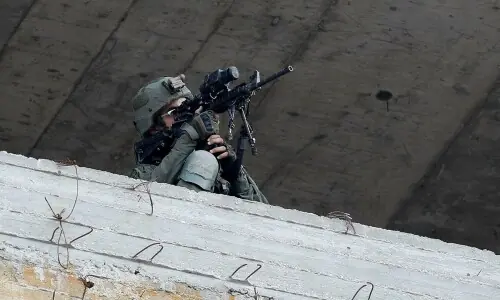
HIDEOUTS attacked, militants killed, damage inflicted — at least that is the official military version of events in North Waziristan Agency. As with any conflict zone, independent reporting is difficult and immediately ascertaining the facts nearly impossible. But a disturbing pattern is emerging in the latest phase of the struggle to try and tamp down militancy in Fata. When retaliation for attacks against the security forces occurs, the claims of success are not just unverifiable in the immediate aftermath, they are not verified even later. As with earlier retaliations, the military seems to be focusing on the overlap between foreign militants and hardline local militants. But while the number of dead militants is always announced with a degree of satisfaction, there is never any visual or factual evidence of the claims made. If this time it was the East Turkestan Independence Movement that reportedly bore the brunt of the attacks, previously it was alleged to be Uzbek militants. But neither then, nor this time is there any evidence to back up the claims. Often, there are not even names. Meanwhile, the human ‘collateral damage’ does come into view quickly enough with civilian casualties appearing in local clinics or before the cameras.
More problematically, what do these retaliations achieve? As has happened over the past couple of days in North Waziristan, even when the military conducts search-and-clear operations, an opportunity is given beforehand for the local population to leave. Surely, most of the militants melt away in the crowd or through other routes. Thereafter, the army tends to blow up homes and buildings associated with militants — leaving physical scars when the population does return. And what of the militants themselves, the bulk of whom leave for other areas? That simply means another retaliation somewhere else is effectively already on the table. If the military’s latest ad hocism in Fata is partly because of the government’s insistence on dialogue being the preferred path, what is happening on the talks front? Surely, this dual policy of allowing the military to retaliate when directly attacked while the civilians try to pursue dialogue with the outlawed TTP is good for neither the military option nor the dialogue one. But can the army and civilians arrive at a more coherent policy?
Published in Dawn, May 23rd, 2014