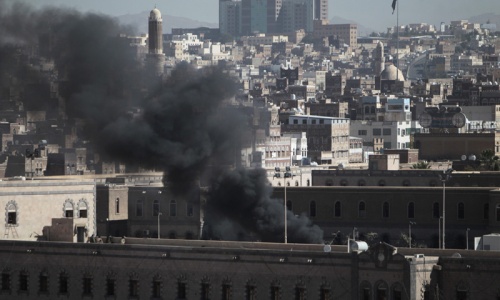
SANAA: Militants who launched a brazen daylight assault on the Yemeni defence ministry that killed 56 people were mostly Saudis, investigators said on Saturday.
The finding, in a preliminary report on the inquiry into Thursday's attack, adds credibility to a claim of responsibility by al Qaeda in the Arabian Peninsula (AQAP), which was formed from a merger of the jihadist network's Saudi and Yemeni branches.
Investigators said the assailants wore military fatigues and penetrated the sprawling Sanaa complex in the confusion created when a suicide bomber rammed a vehicle into the gate.
They said the bodies of 12 attackers were recovered after security forces regained control of the area. A hospital in the complex bore the brunt of the assault.
Among the dead were medics from the Philippines, Germany, Vietnam and India. Civilian patients as well as soldiers were also killed, Yemen's supreme security committee said.
On Friday al Qaeda said it was behind the assault, alleging that the complex hosted US personnel behind drone strikes against its militants.
There was no immediate evidence to support that claim.
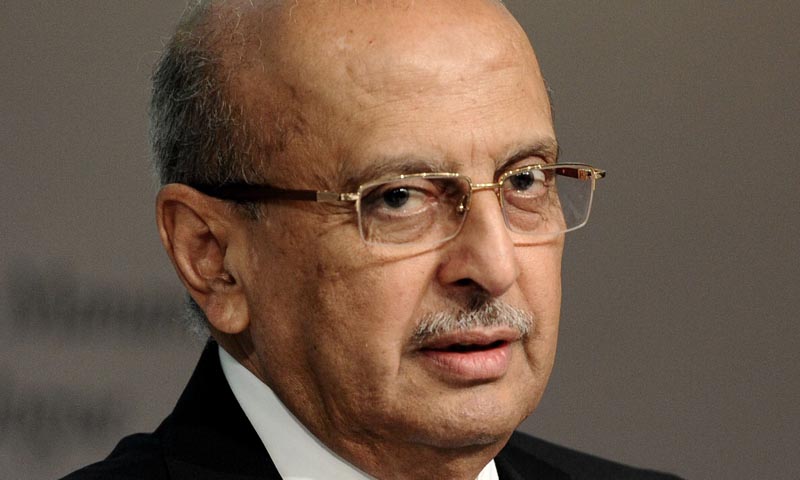
Speaking to AFP on the sidelines of a regional security meeting in Bahrain, Yemeni Foreign Minister Abu Bakr al-Kurbi said the findings represent “a possibility, but there is no evidence. We should wait for the final results of the investigation.”
Yemeni analyst Saeed al-Jamhi, who specialises in al Qaeda affairs, said the attack reflects “the level of the network's penetration into security and military services” and shows it has access to “high-level information”.
The attack followed a spate of hit-and-run strikes on military personnel and officials, as the country struggles to complete a thorny political transition.
But Kurbi insisted that the attacks “do not threaten the transition process”.
“Al Qaeda takes advantage of any political vacuum. I hope this latest attack will press participants to double their efforts to ensure the success of the national dialogue,” he said.
Yemen has been going through a difficult political transition since veteran president Ali Abdullah Saleh stood down in February 2012 after a year of deadly protests against his 33-year rule.
The transitional process aims to produce a new constitution, paving the way for parliamentary and presidential elections in February, but many hurdles remain.
There are growing demands for the secession of the formerly independent south, in addition to on-off fighting in the north between Shia Muslim rebels and hardline Sunnis.
The national dialogue that began in March and was originally due wrap up in September has yet to conclude.
“What's important is to finalise the specific task, agreeing on a constitution, a referendum and elections,” Kurbi said.
AQAP took advantage of a decline in central government control during Yemen's 2011 uprising to seize large swathes of territory across the south.
The militants were driven back in June 2012 and the group has since been further weakened by US drone strikes.