The first Balochistan and Khyber Pakhtunkhwa (KP) governments did not last long. One cannot say what the exact point of departure was, but political observers attribute it to the urge of setting up PPP-led governments there as well. Both the governments lasted only 10 months (April 1972 to February 1973). In the first instance Bhutto replaced the governors of Balochistan and KP on February 14, 1973. The Balochistan government was dismissed the same day, and the next day JUI-NAP government in Frontier resigned in protest.
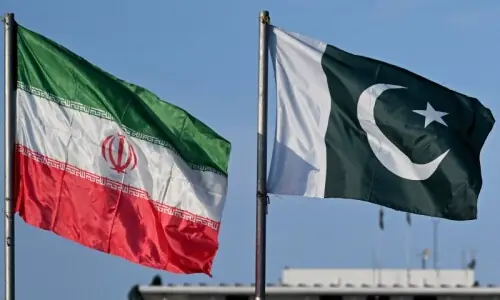
The political situation which turned ugly is generally linked to two things. First the discovery of a huge arms cache from the Iraqi embassy in Islamabad on February 10, said to have been sent for the so-called Baloch liberation fighters, who were thought to be supported by Iraq, supposedly in response to Iran’s support for Iraqi Kurds. Iran had, for quite some time, taken armed action against Irani Balochistan activists who were said to have been struggling for the creation of Greater Balochistan by including parts of Pakistani Balochistan. The Shah of Iran did not want an independent Balochistan on its borders and had asked Bhutto to silence the supporters of Greater Balochistan.
An echo of London Plan is also said to have been associated with the Balochistan situation. The plan, as told by Nawab Akbar Bugti, was hatched by Shaikh Mujibur Rahman for dividing Pakistan into four states. He claimed that the NAP-led governments in Balohistan and KP were supporting the movement to earn freedom from Pakistan. He also claimed that Attaullah Mengal and Wali Khan were working for a free Balochistan. Reacting to the advice of his interior minister, Khan Abdul Qayyum, Bhutto ordered the dismissal of Balochistan government and the arrest of Attaullah Mengal, Ghaus Bakhsh Bizenjo, Khair Bakhsh Mari and dozens of NAP activists.
In fact, the Balochistan government was already facing difficulties. It wanted to raise its own law enforcement force, as a large number of police personnel hailed from other provinces, especially from Punjab and KP. At the time of dismemberment of One Unit it was promised that all such employees would return to their province of origin but it did not happen.
After the federal government abolished the Civil Armed Force, the provincial government established a police force of local people to fill the vacuum. But when trouble erupted in Pat Feeder area in January 1973, which caused commotion in the rest of the province too, and the local police rushed to the scene, the central government did not allow it to handle the situation. Bhutto ordered the federal troops to take over, on the pretext that it had become a haven for ‘secessionists’. Nawab Akbar Bugti had alleged that Governor Ghaus Bakhsh Bizenjo was behind the whole move. The day Bizenjo was dismissed, Akbar Bugti was appointed governor in his place.
Perhaps Bhutto himself did not want to see non-PPP governments in the border provinces. But in the absence of some cognisable cause it was difficult to establish a PPP-led coalition government there. He, therefore, launched action by interfering in the provincial affairs. In Balochistan, Bhutto had already engaged Akbar Bugti, Abdus Samad Achakzai, Mir Nabi Bakhsh Zehri and Jam Sahib of Lasbela and now it was KP’s turn to undergo changes for the final onslaught. He decided to replace Arbab Sikandar Khan Khalil with Mohammad Aslam Khatak, head of an eight-member United Front, as governor of KP. Balochistan was already under Presidential rule, now Frontier was also put under it.
Despite the political skirmishes NAP leader Wali Khan continued to hold talks with Bhutto on constitution and supported him on many issues. Though there were differences over provincial subjects and renaming of NWFP, Wali Khan retained a very cordial attitude. He agreed that the issues of judicial independence and provincial subjects would be delegated to the provinces after the transition period of five and 10 years. The agreement ensured hydel royalties for KP and Balochistan and equal development for all regions.
While the problem of Balochistan was yet to settle, Bhutto did not hesitate to send troops to Balochistan to “search for miscreants and activists of Baloch Liberation Army”. The operation took place under the command of General Tikka Khan, the C-in-C continued till after the end of PPP rule in 1977. Regarding the Balochistan operation Bhutto sent a warning that, if found, all ‘miscreants’ would be finished forever. In fact, this was the beginning of an unending clash which forced Baloch nationalists into direct conflict with the government.
Decades later, the situation is still very grim. After 40 years of the first attempts to pacify Baloch population demanding their rights and incessant atrocities committed by subsequent governments, the people of Balochistan are still living in mise?ry, deprivation, injustice and state terrorism. After the 2008 elections, a new phenomenon of kidnapping of Baloch political workers has emerged which has been actively taken up by the Supreme Court.
shaikhaziz38@gmail.com