0
0

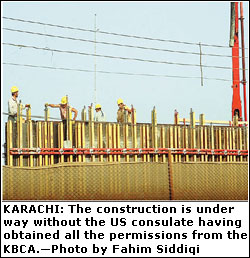 KARACHI, Nov 10: A new hazard to the safety and security of citizens is coming up fast at the place where Maulvi Tameezuddin Khan Road (formerly Queen’s Road) and the Mai Kolachi Bypass meet: at this spot is being built the new complex housing the consulate general of the United States of America.
Dawn has learned from reliable sources that in addition to posing a security risk to residents of the area, the diplomatic mission of a country that otherwise professes to be a strict follower of the rule of law is also violating certain building codes.
The diplomatic mission is being relocated from its current premises on Abdullah Haroon Road, where the high level of security demanded by it has caused great traffic disturbance since the road constitutes one of the major traffic arteries connecting the downtown with the upmarket localities of DHA, Clifton and others.
Sources maintain that the new location will endanger the security of citizens living at the nearby low-income locality of Sultanabad and the residences of the naval officials. An earlier proposal to shift the consulate to a seven-acre amenity plot reserved for the Hippodrome in Clifton was scuppered by protesting residents of the locality who feared for their security. The people living around the new location, however, are unlikely to be able to mount much opposition since they have less knowledge of their rights and their protests are likely to go unheard, sources pointed out. They added that with the new location, the movement of workers and traffic to and from the port, and that of public transport vehicles currently plying these busy roads, would also be affected just as certain vehicles were banned from Abdullah Haroon Road because of the consulate’s security concerns.
Dawn was informed that in fact, the threat to the consulate may even increase at the new location since M.T. Khan Road and the Mai Kolachi Bypass are used by all kinds of vehicles, including trailers carrying 40-foot containers that could inflict huge amounts of damage if used for terrorist purposes. By contrast, Abdullah Haroon Road is routinely used only by small vehicles with a limited capacity to carry explosive loads.
The diplomatic mission is being constructed on a plot measuring over 20 acres obtained under lease from the Karachi Port Trust for over a billion and a half rupees, said sources. The government exempted the consulate from the registration fee, thus robbing the public exchequer of millions of rupees. Meanwhile, the earlier tenant of the spot, a federal government research organisation that had been operating from the plot for over five decades, was evicted and had to relocate itself to relatively small premises in a high-rise building.
Following the pattern of the British deputy high commission complex in Clifton, the United States consul-general plans to construct offices as well as staff residences in the new complex to avoid its staff being exposed while commuting to and from their workplace.
Construction irregularities
The United States consul-general failed to apply for certain permissions and NOCs in connection with the new complex. These would easily have been granted had the request been made by the diplomatic mission, but in their absence, the consulate is guilty of building irregularities and of breaking the rules, sources informed Dawn.
Reportedly, the USCG submitted plans for the boundary wall with the Karachi Building Control Authority (KBCA) and these plans were approved. However, the law required the mission to inform and seek KBCA permission before starting construction, which it failed to do, thus rendering the construction work under way unauthorised and illegal.
Furthermore, the complex’s fortification walls are being constructed of steel blocks as opposed to the usual cement and concrete. While this may deter suicide bombers from targeting the compound as they have done in the past, permission from the KBCA should have been sought, Dawn has learnt. Sources within the KBCA also pointed out that while the height of boundary walls is normally kept between six and eight feet, the request for an increase could have been made to and granted by the KBCA in view of safety concerns. The steel walls currently being constructed are well over 10 feet high but no specific permission was sought by the USCG.
Additionally, the law requires that when the construction reaches plinth level, the constructor must inform the KBCA which would then conduct a survey, examine the construction and ensure that the approved plan is being followed.
After this, the KBCA issues a certificate giving the construction a go-ahead. Introduced to ensure that notorious builders did not deviate from approved plans or encroach on land that did not belong to them, this plinth-level certificate is mandatory.
However, sources pointed out that since the USCG had not even informed the KBCA about its intention to initiate construction, the question of getting the plinth-level certificate did not arise and it had not been issued by the KBCA.
An undertaking submitted with the KBCA by a USCG official states that he is the owner of the plot which is incorrect since in actual fact, the over 80,000 square yards of land were obtained on lease.
Repeated attempts made by Dawn to elicit an official statement on the issue from KBCA officials met with failure. Meanwhile, Mushtaq Rajpar of the USCG promised a response from the diplomatic mission by Friday afternoon, but this was not received until the time these pages went to press.