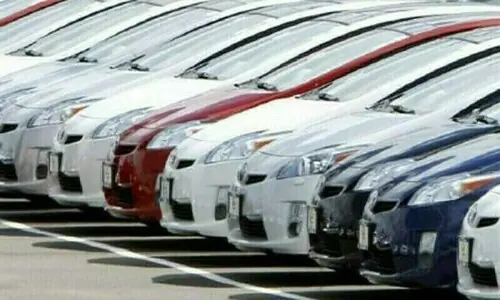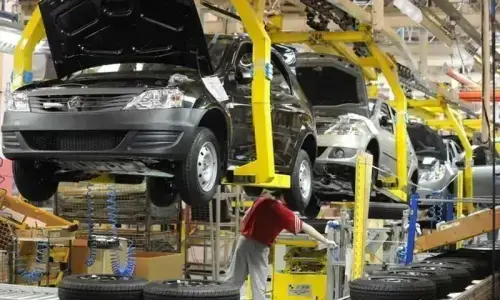
Pakistan’s automobile industry has entered one of its most uncertain phases in over a decade. As part of the government’s tariff rationalisation commitments under the International Monetary Fund (IMF) programme, the protective gap between imported completely built-up (CBU) vehicles and locally assembled completely knocked-down (CKD) vehicles has been sharply reduced to just about 15 percentage points.
While the objective is to liberalise trade and gradually expose domestic manufacturers to greater competition, the industry argues that the reform has fundamentally altered the economics of local vehicle assembly.
“This has narrowed the protection available to local manufacturers who invested under two previous auto policies (of 2016-21 and 2021-26),” notes the chief financial officer (CFO) of a car company, refusing to give his name.
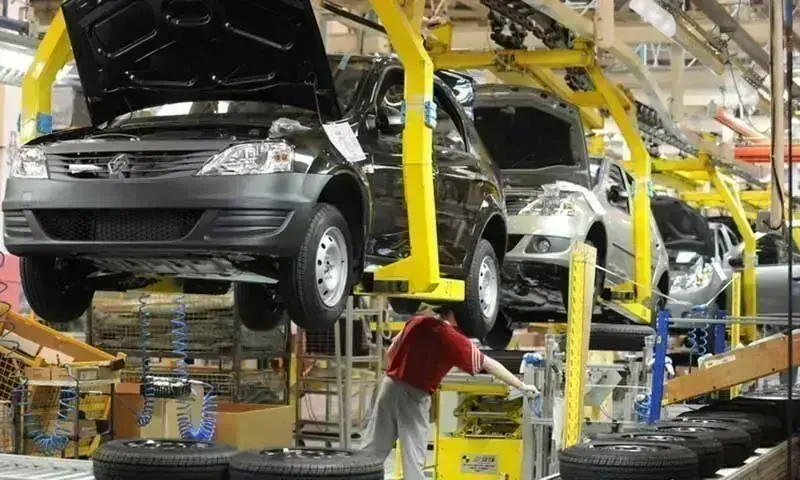
“Investors who established local assembly plants will now be competing against imported vehicles with substantially lower duty incidence.” For decades, Pakistan’s automotive policy relied on tariff protection to encourage companies to assemble vehicles locally rather than import finished vehicles. That protection justified billions of rupees invested in assembly plants, tooling, localisation and vendor development.
Reducing tariffs on imported cars has fundamentally altered the economics of local vehicle assembly
The CFO argues that this makes local CKD assemblers uncompetitive against imported CBUs, shrinking the incentive to manufacture domestically besides putting tens of thousands of jobs at stake. “Existing manufacturing capacity may become idle, and the vendor industry will face closures while pressure on meagre foreign exchange reserves will rise.” Ali Asghar Jamali, chief executive officer of Indus Motor Company, says the revised tariff structure has created an anomaly where importing a fully built car is actually cheaper than importing CKD kits for local assembly.
“While this current inversion temporarily disincentivises assembling cars locally, I expect the government will step in soon to rectify this anomaly.” The industry’s anxiety is understandable given the achievements of the previous policy cycle. The auto policy 2016-21 marked a turning point by offering incentives to greenfield investors, attracting several new manufacturers and mobilising more than $1 billion in investment in assembly plants.
Greater competition reduced the dominance of the traditional assemblers and expanded consumer choice.
Building on that momentum, the auto policy 2021-26 sought to position Pakistan for the global transition towards cleaner mobility by extending incentives to battery electric vehicles, hybrid electric vehicles, plug-in hybrid electric vehicles, range-extended electric vehicles and fuel-cell vehicles.
That transition, however, now appears to have stalled, at least temporarily.
Former Pakistan Association of Automotive Parts and Accessories Manufacturers chairman Syed Nabeel Hashmi argues that tariff reform should not come at the expense of domestic industry. “Tariff rationalisation should improve competitiveness, not eliminate the economic case for manufacturing in Pakistan,” he says. “If importing a finished vehicle becomes almost as attractive as assembling it locally, investment will naturally move away from production.” The issue extends well beyond tariffs.
Pakistan’s automotive industry supports an ecosystem of more than 2,000 parts manufacturers and tens of thousands of skilled and semi-skilled jobs. A sustained shift from local assembly towards imports would reduce demand for domestically produced components, discourage investment in localisation and technology transfer, and weaken industrial capabilities that have taken decades to build.
“At a time when Pakistan urgently needs industrialisation, foreign direct investment, exports and productive employment, an import-biased tariff structure risks rewarding trading activity over domestic value addition,” notes the CFO.
Policy vacuum
The timing has amplified the industry’s concerns. The tariff rationalisation has taken effect just as the Auto Industry Development and Export Policy (AIDEP) 2021-26 expired on June 30. With its successor yet to be finalised, investors are left without a clear roadmap for the future.
While the broader auto policy is finalised, the government has extended the one per cent sales tax concession for locally assembled smaller electric vehicles (EVs) with battery capacities of up to 50kWh and light commercial EVs up to 150kWh until June next year.
Incentives for hybrids, however, have lapsed.
Sales tax on locally assembled hybrid and plug-in hybrid vehicles above 1,400cc has increased to 25pc, replacing the earlier concessional rates of 8.5pc for engines below 1,800cc and 12.5pc for engines above 1,800cc. Hybrids with a capacity below 1,400cc pay a sales tax rate of 18pc.
Consequently, hybrid technologies now face a tax burden much closer to conventional internal combustion engine (ICE) vehicles following the withdrawal of concessional sales tax. “This effectively stalls the rollout of locally assembled hybrid vehicles by wiping out their price advantage over comparable ICE models,” the CFO says. “Several manufacturers have already suspended CKD imports until there is greater policy clarity. Clarity is essential because automobile manufacturing is a long-term business. Investors commit capital for 15 to 20 years.” Mr Jamali, however, has a different take on this. “The 2021-26 auto policy has officially run its course, and what follows is simply a return to the standard sales tax rates for hybrid vehicles.
Those who invested for these concessions were well aware that the policy was for five years. It is a very straightforward transition.
The path forward is equally simple: either the government formally extends the previous incentives, or they introduce a new policy framework explicitly defining the next phase of support for local assembly. Silence is the only thing keeping the market waiting.” The government’s room for manoeuvres is constrained by its commitments under the IMF programme. Nevertheless, a more balanced approach may still be possible. Industry representatives argue that if the previous concessional sales tax rates cannot be restored, hybrid vehicles — particularly plug-in hybrid electric vehicles — should at least be taxed at the standard 18pc rate rather than the higher rate currently applied.
Such an approach would preserve some incentive for hybrid technologies while remaining more consistent with fiscal constraints.
Industry players argue that trade liberalisation, if pursued without complementary industrial policies, can weaken domestic manufacturing capacity rather than strengthen competitiveness.
The broader strategic question is what kind of automotive industry Pakistan wishes to build.
As Mr Hashmi notes, regional competitors continue to deepen their manufacturing base using industrial policy. India, for instance, continues to attract major investments, including Maruti Suzuki’s reported 35,000 crore commitment for a new manufacturing facility in Gujarat. Pakistan, by contrast, risks sending the opposite signals.
Pakistan needs a credible long-term automotive strategy that provides policy certainty, maintains meaningful incentives for localisation and technology upgradation, and supports the transition to cleaner mobility.
Published in Dawn, The Business and Finance Weekly, July 20th, 2026