Korean monks call Taxila ‘spiritual root of Mahayana Buddhism’
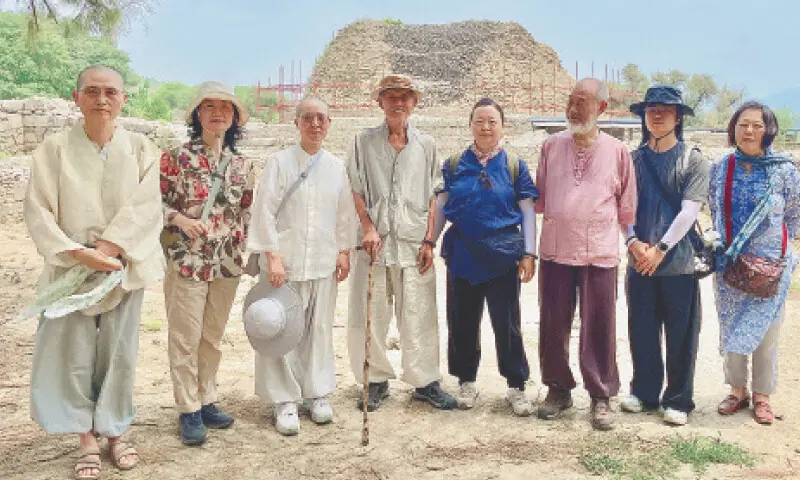
TAXILA: Describing Taxila as the “spiritual root of Mahayana Buddhism”, a senior Korean Buddhist monk on Sunday said the ancient Gandhara civilisation remained central to the religious identity of Korean Buddhists, urging greater efforts to preserve Pakistan’s Buddhist heritage and promote it as a destination for religious tourism.
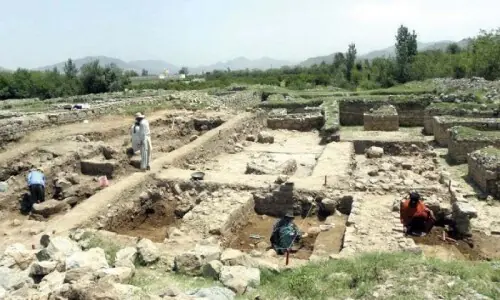
Standing amid the serene ruins of the 2,000-year-old Dharmarajika Stupa, one of the holiest Buddhist shrines in the ancient Gandhara civilisation, most venerable Jong Lim said his latest pilgrimage to Pakistan might be his “tenth or perhaps last” visit, but his bond with Taxila had only grown stronger over the years.
“Every time I return to Taxila, I feel a much deeper emotional and spiritual connection than anywhere else,” the 85-year-old revered monk told journalists.
“Although I have visited numerous Buddhist sites in India and many other countries, nowhere touches my heart like Gandhara because Korean Buddhism traces many of its Mahayana roots to this sacred civilisation. The spirit of this land still lives in the Korean Buddhist tradition.”
The eight-member Korean delegation, comprising senior monks, Buddhist scholars and researchers, included lady monks Hyo Rok and Yoo Yeon; renowned academic Professor Lee Jong; PhD scholar Choi Bong Ju; and other distinguished members who travelled to Pakistan on a religious pilgrimage to explore the ancient centres of Buddhism in Gandhara.
With visible emotion, most venerable Jong Lim said, “Gandhara is not merely an archaeological site; it is a sacred spiritual landscape. This is where the message of compassion, wisdom and enlightenment travelled to the rest of Asia. Korea embraced that message centuries ago and transformed it into a vibrant spiritual and cultural heritage. That is why I always say, Gandhara is the root of Mahayana Buddhism, and Korea is its flower.”
Professor Lee Jong, while speaking to reporters, said Pakistan occupied a unique place in the religious consciousness of the Korean people because of its association with the ancient Buddhist civilisation of Gandhara.
Professor Lee noted that according to long-held Korean Buddhist traditions, Marananatha, the monk credited with introducing Buddhism to the Korean kingdom of Baekje in 384 AD, originated from the ancient region corresponding to present-day Pakistan. “The Gandhara civilisation remains one of the greatest attractions for Buddhists from across the world, and its preservation offers immense opportunities to strengthen cultural, religious and people-to-people ties between Islamabad and Seoul.”
Talking to newsmen on this occasion, Project Director Gandhara International Research Centre, University of Lahore, Dr Kyosoon Park stated that for two decades she had worked to build a bridge between Korean Buddhists and Pakistan, and this visit of Korean monks and scholars would help not only promote a soft image of Pakistan but also attract religious tourists.
The delegation toured the Taxila museum, where officials gave them an overview of Gandhara civilisation, Buddhist artefact and the ancient history of the region.
Members of the group showed strong interest in Taxila’s globally recognised heritage and appreciated its historical importance.
During their visit, the museum’s collection provided a glimpse into the history and significance of Buddhism, leaving a lasting impression on the visiting monks.
Deputy Director Department of Archaeology, Asim Dogar, informed the Korean delegation that the department was committed to preserving, promoting, and presenting our shared heritage to the world, making Punjab a hub of cultural exchange and tourism.
Published in Dawn, July 20th, 2026