Effective global AI governance a must to address challenges
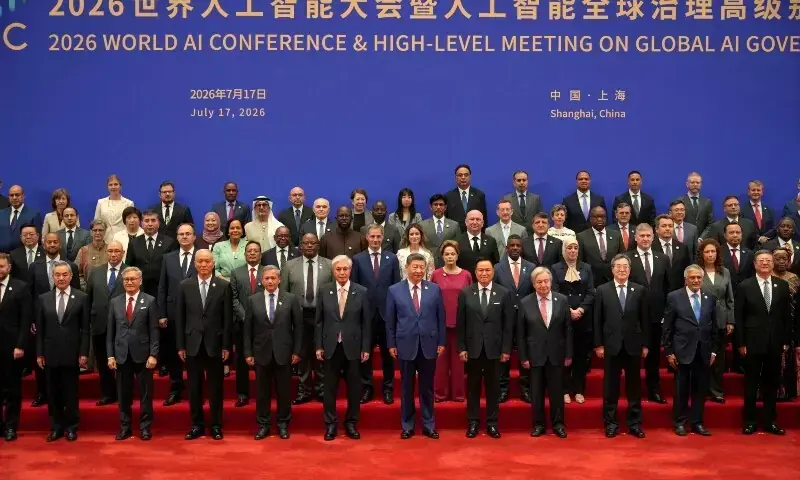
THE 2026 World AI Conference and High-Level Meeting on Global AI Governance, which opened in Shanghai, has built a timely platform for the international community to seek collective answers to the defining questions of the AI era through dialogue, cooperation and coordinated action.
The conference reflects China’s commitment to promoting AI for good, advancing innovation through cooperation and strengthening global governance with consultations. It sets out practical initiatives and concrete pathways to ensure that AI benefits all humanity.
In his keynote speech at the opening of the conference, President Xi Jinping put forward four observations on AI development and governance: countries should adhere to the principle of openness and win-win cooperation and boost innovation-driven development; strengthen risk-awareness and ensure that AI is secure and controllable; encourage inclusiveness and promote mutual learning between civilisations; and advocate solidarity and improve global governance.
These observations reaffirm China’s long-standing adherence to a people-centered approach to AI — one that advances common prosperity, upholds overall security, and contributes to building a community with a shared future for humanity. They also point the way toward turning this vision into practical action and tangible results.
In recent years, China has promoted interplay between an efficient market and a well-functioning government, strengthened AI innovation, advanced the AI Plus Initiative, and built a healthy ecosystem for all entities to thrive in together. It also lays great emphasis on safety and security in AI development. The nation is continuously improving laws, regulations, policies, mechanisms, application norms as well as ethical principles to make sure that AI is safe, secure and controllable.
The 15th Five-Year Plan (2026–30), launched this year, is not only a blueprint for China’s socioeconomic development over the period, but also a roadmap that creates new opportunities for the international community, including in AI and other emerging sectors.
As a responsible major country, China has consistently contributed international public goods to advance global AI governance. In the latest step toward that goal, Xi said that in the next five years, China will provide developing countries with 5,000 opportunities in AI training and seminar programs; develop international AI application cooperation centers with the Association of Southeast Asian Nations, the League of Arab States, the African Union, the Community of Latin American and Caribbean States, the Shanghai Cooperation Organization, and BRICS; and enable 30 countries to use the AI-powered meteorological warning system, or MAZU, to safeguard homes around the world.
Another major outcome of the conference was Xi’s announcement of the establishment of the World Artificial Intelligence Cooperation Organisation. Headquartered in Shanghai, the world’s first intergovernmental international organization to cope with opportunities and challenges posed by AI aims to promote fair, equitable and inclusive global AI governance.
Notably, the conference also issued a chair’s statement outlining a comprehensive vision for effective global AI governance. It called for fostering an innovation ecosystem driven by enterprises, markets, research, applications and talent, while advancing the AI Plus model to expand AI applications across key sectors.
The statement also advocated responsible open-source collaboration, stronger data governance, sustainable AI development, enhanced AI education and skills training, and robust legal, technical and ethical safeguards. It urged all countries to strengthen multilateral cooperation under the United Nations, prevent the misuse of AI, promote fair international standards and industrial cooperation, support developing countries in sharing AI opportunities and respect cultural diversity.
The Shanghai conference therefore produced substantive outcomes, reflecting China’s farsighted and systematic solutions to challenges of AI development and governance. Addressing almost every critical dimension of AI — from innovation, industry and employment to ethics, security, sustainability and international collaboration — it has set out a pragmatic framework for harnessing AI for the common good of humanity.
Published in Dawn, July 20th, 2026