Peshawar High Court seeks govt response to plea for regulating acid sale
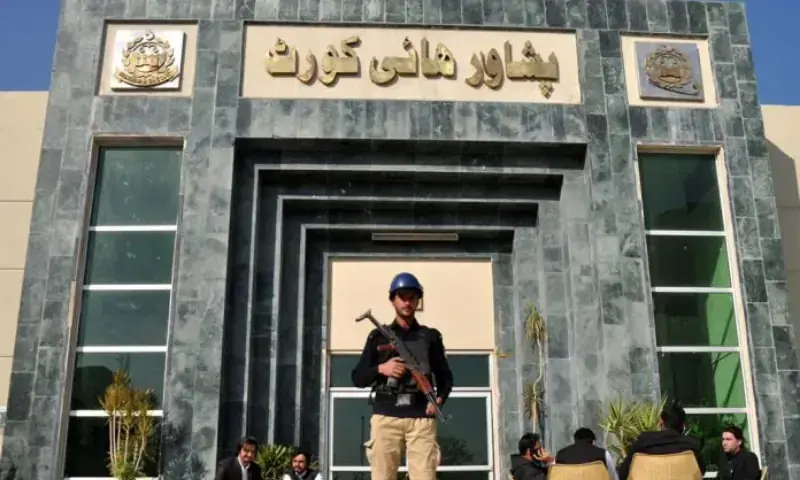
PESHAWAR: The Peshawar High Court has issued notices to the federal and the provincial governments for responding to a petition filed for regulating retail sale of acid and other corrosive substances in the province.
A bench consisting of Justice Ijaz Anwar and Justice Farah Jamshed issued the order after holding a preliminary hearing into the plea jointly filed by Aimen Jehangir and two other lawyers.
The petitioners requested the court to declare that the unrestricted, unregulated and unmonitored retail sale of concentrated corrosive acids and hazardous chemical compounds without licensing and identification tracking is unlawful, arbitrary and a violation of articles 4, 9, 14 and 25 of the Constitution.
They sought the court’s orders for the government to frame and enforce comprehensive rules under the Acid Control and Acid Crime Prevention Act, 2011, ensuring strict licensing of sellers, mandatory buyers identification and safe storage and transport of concentrated acid.
Petitioners insist unrestricted availability of corrosive substances is illegal
The petitioners also requested the court to direct authorities, especially the Khyber Pakhtunkhwa home department, to immediately frame, notify and implement comprehensive rules, statutory regulations and standard operating procedures governing the manufacture, storage, commercial transit, retail distribution and final sale of all corrosive acids.
The respondents in the petition include the federal government through the interior secretary, KP government through its chief secretary, KP secretaries of health and home departments, KP inspector general of police and the director-generals of the KP Drug Control and Pharmacy Services and the Pakistan Standard and Quality Control Authority.
Advocate Ayesha Malik appeared for the petitioners and said that open and unrestricted sale of acid and other corrosive substances across the country operated as a permanent weapon for gender-based violence and public terror.
She added that acid attacks were not mere conventional crimes and instead, they constituted acts of extreme barbarity that targeted the physical existence, psychological integrity and social identity of the victim.
“Despite the existence of the Criminal Law (Second Amendment) Act, 2011, commonly called as Acid Control and Acid Crime Prevention Act, 2011, penalising act of acid attack, it has proved insufficient as a deterrent to such crime due to easy availability of acid and other corrosive substances on the market.
The respondents’ systematic failure to formulate, implement and enforce regulatory and licensing framework for the retail sale of acids constitutes an active breach of their statutory duty and a direct violation of fundamental rights guaranteed under the Constitution,” she said.
The lawyer cited several incidents of acid attacks including a recent one on a woman doctor in a Quetta hospital, arguing that even workplaces are not safe from such attacks.
She contended that when the state had a clear foresight of a lethal public hazard and possessed the executive machinery to restrict it, its continuous failure to act amounted to criminal negligence and rendered it vicariously liable for ongoing violation of the people’s right to life.
Ms Malik requested the court to direct the respondents to ensure that no corrosive chemical is sold without mandatory CNIC, biometric or physical verification, recording of the explicit purpose and the mandatory maintenance of digital or physical registers of customers, open to executive inspection.
She also said that the home and health secretaries should be directed to immediately audit and upgrade security protocols for female employees, staff and practitioners in all public and private healthcare facilities and educational institutions in KP to ensure a harassment and violence-free workplace.
Published in Dawn, July 18th, 2026