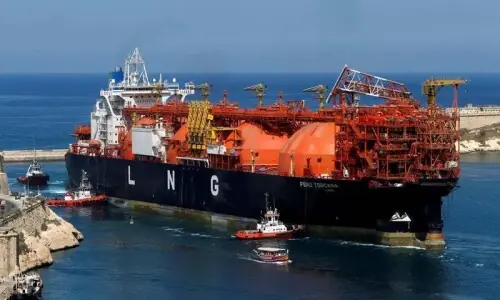
Earlier this year, when the Iran conflict disrupted oil flows across the Strait of Hormuz, every fuel-importing economy in the region had to recalculate its energy security. The cost of an LNG cargo into Karachi rose. The risk premium on Middle Eastern crude widened. Insurance rates for Gulf shipping spiked. Pakistan, predictably, did the same defensive arithmetic it has done in every previous regional shock: how much foreign exchange will this cost, how long can it be sustained, and what happens if it gets worse?
What was different this time, and what most of Pakistan has not fully absorbed, is that we did the arithmetic from a structurally different starting point. The country was already generating more than 25 per cent of its electricity from solar.
Pakistan’s fossil-fuel imports had fallen by roughly 40pc between 2022 and 2024, and (un)surprisingly, this did not happen by policy design. It happened through the cumulative effect of a decade of household-level capital deployment that no government planned, and no International Monetary Fund (IMF) programme prescribed.
The household-financed energy transition has brought about a kind of strategic autonomy that no government policy in the same period has produced
This is the most important fact about Pakistan’s solar boom, and it is also the one we have been least willing to discuss honestly. The transition to solar is no longer primarily about climate. It is, in effect, about sovereignty.
The numbers we have not internalised
Since 2020, Pakistan has avoided over $12 billion in oil and gas imports through solar substitution, according to a joint analysis by Renewables First and the Centre for Research on Energy and Clean Air. The country is projected to save another $6.3bn in 2026 alone at current fuel prices. These are not climate-policy numbers. They are balance-of-payments numbers, foreign-exchange-reserve numbers, and current-account numbers.
For an economy that has spent two decades managing a chronic foreign exchange crisis, where every IMF programme, every devaluation cycle, and every period of capital controls has had energy imports at the centre of it, this is a structural improvement of a magnitude that most policymakers have not yet registered. Pakistan’s energy import bill in FY22 hit a record $23.32bn, accounting for nearly 29pc of total imports. Without the solar substitution of the last five years, that number would now be materially higher.
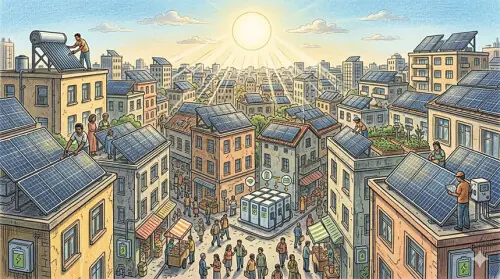
The solar boom happened because individual Pakistani households and businesses decided that an unreliable, unaffordable grid was no longer their only option, and they deployed their own capital, roughly $8–10bn of it cumulatively, to do something about it. That decentralised, household-financed energy transition has brought Pakistan a kind of strategic autonomy that no government policy in the same period has produced.
What the Iran crisis exposed
Pakistan has seen oil shocks before. The pattern, unfortunately, has always been the same. Gulf disruption raises crude prices. The country’s import bill spikes. The current account widens. The rupee weakens. The IMF programme tightens. Industrial activity contracts. Power tariffs rise to cover independent power producers’ (Discos) recovery shortfalls. And households, as they always do, absorb the cost.
Earlier this year, the early stages of that pattern began to unfold. However, the magnitude of the shock was contained in a way it would not have been even five years ago. Pakistan was importing less fuel to generate the same electricity. Rooftop solar was offsetting daytime demand that would otherwise have required imported LNG. The country was, for the first time in its modern history, partially insulated from a Gulf disruption.
Why this framing matters
The current policy conversation around solar, whether on net billing, Disco cross-subsidy, or import duties, has been conducted almost entirely as a climate-and-cost conversation. These are legitimate questions, but they are not, in my view, the most important ones.
The most important question is this: in a region where energy supply is structurally vulnerable to geopolitical disruption, whether through Iran, the Strait of Hormuz, the Red Sea, Russian gas or Qatari LNG, what fraction of Pakistan’s electricity demand can be served from domestic capital, on Pakistani rooftops, using Pakistani sunshine?
The current answer is roughly 25pc. The achievable answer, with reasonable policy support over the next decade, is 40 to 45pc.
What this reorientation requires
Treating solar as a national-security policy rather than a climate policy fundamentally changes what the government should be doing.
The federal budget should treat solar substitution as a strategic priority on par with food security and water security. The State Bank of Pakistan’s renewable energy financing scheme, currently dormant, should be restarted and dramatically expanded.
The National Electric Power Regulatory Authority’s regulatory posture should also be reframed: the current Prosumer Regulations treat rooftop solar primarily as a Disco cross-subsidy problem; a national-security framing would treat it as a strategic asset whose deployment should be optimised, not constrained.
Most importantly, the government should own the framing publicly. Treating solar as a national-security asset rather than a green-policy nicety would change how it is featured in the country’s strategic doctrine.
Pakistan has spent most of its modern history managing energy as a vulnerability. The solar boom has begun to change that. Pakistan is becoming, in this narrow but consequential sense, more sovereign, more resilient, and less exposed. What we have not yet built is the policy framework to consolidate that change, nor the political consensus that solar is no longer an environmental amenity but a strategic asset. We should build both.
The writer is an advocate of renewable energy and the CEO of Solar Citizen. Email: mujtaba.raza@solarcitizen.com.pk
Published in Dawn, The Business and Finance Weekly, June 1st, 2026