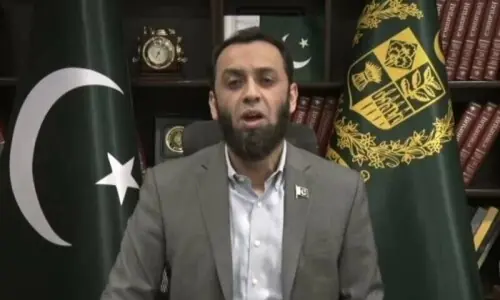
India waging ‘low-intensity war’ against Pakistan from Afghanistan, says Asif


Defence Minister Khawaja Asif has stated that India is waging a “low-intensity” war against Pakistan from Afghanistan, adding that New Delhi is trying to “settle the score” after facing defeat in the four-day conflict with Islamabad in May.
Asif expressed these views during an interview with Al Arabiya English that was released late on Wednesday. His remarks are a continuation of the censure he has been directing toward Kabul in connection with terror incidents in Pakistan, recent border hostilities and the subsequent failure of talks with its Taliban rulers.
He was asked during his interview with Al Arabiya about the evidence he had to back his assertions that New Delhi was “pulling the strings” during talks with Taliban representatives in Doha and Turkiye.
“When it comes to showing the evidence, or tabling the evidence, we will do that. We have the evidence,” Asif replied, highlighting that the Afghan foreign minister was visiting the Indian capital when border clashes began between Pakistan and Afghanistan.
He went on to say that there was no doubt about Afghanistan having become an “Indian proxy”.
“And India is actually waging a low-intensity war against us from the Afghan territory and trying to settle the score [after] the last round we had around six or five months back, when they were squarely defeated. And they lost seven planes.
“The president of the United States has, on several occasions, mentioned — he even mentioned it yesterday — that seven beautiful planes were lost in the clash between India and Pakistan,” he added.
The conflict between the two countries in May was sparked by an attack on tourists in occupied Kashmir, which New Delhi, without evidence, linked to Pakistan. Islamabad strongly denied responsibility while calling for a neutral investigation.
New Delhi then launched deadly air strikes in Punjab and Azad Kashmir on May 7. After tit-for-tat strikes on each other’s airbases during the four-day escalation, it took American intervention on May 10 for both sides to finally reach a ceasefire. Pakistan initially said it had downed five Indian planes in air-to-air combat, and later raised the tally to seven.
US President Donald Trump has also mentioned the downing of seven jets during the conflict on multiple occasions, but has stopped short of elaborating on which side lost the jets.
When Asif again referred to the May episode in the context of hostilities between Pakistan and Afghanistan, the interviewer remarked that him saying India was trying to take revenge using another country was a very bold statement.
At that, Asif replied, “You want me to reiterate that statement? I will do that. I have no problem with that.” He continued that Kabul and New Delhi had a “relationship irrespective of the regimes in both countries”.
“There is a continuity to the relationship between the two countries, and it has always been to the detriment of Pakistan.”
Responding to a subsequent question, he also warned that in case of any violation on Pakistan’s eastern or western border — frontiers that the country shares with India and Afghanistan — Islamabad would respond effectively.
The defence minister further commented that Afghanistan had “chosen to become a stooge or proxy of India”.
Asked whether he saw a “broader or full-blown war” with Afghanistan on the horizon, the defence minister replied: “I won’t speculate about this, that there could be a full-blown war. But, there is a risk of [things] heating up, at least on the border. And obviously, if we have evidence of indulgence from across the border, we will retaliate. We will go inside and settle the score with them.”
The interviewer also asked him where Pakistan stood with regards to sending troops to become part of an international force in Gaza.
“We [have] already [said] on record that if need be we will be part of that force to maintain […] peace and tranquility and […] normalisation [of situation] in Gaza. Pakistan will always be willing to render its services in this regard,” replied Asif.
In response to a question about online “chatter” that Pakistan had tested a hypersonic missile over Quetta, the defence minister said it was just speculation.