l Government study says 77pc of 10-year-olds cannot read simple text
l Calls for stronger funding, teacher quality and learning systems
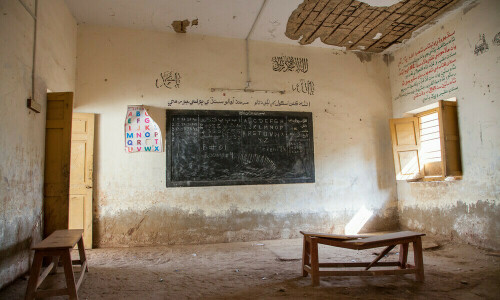
ISLAMABAD: The country continues to face critical challenges in financing and ensuring access to education, revealed a government report released on Thursday.
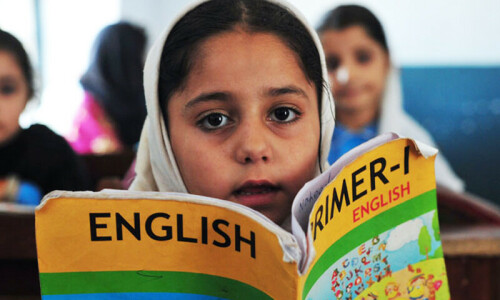
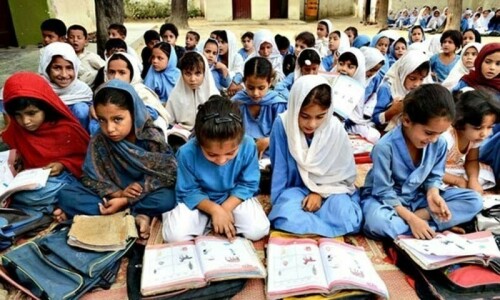
With an alarming number of out-of-school children and 77 per cent of ten-year-olds unable to read and understand a simple text, the urgency of aligning financing priorities with teacher quality, learning materials and stronger assessment systems has never been greater.
The country’s declining trend in education spending also reflects a progressive weakening of education’s position within the national fiscal framework.
These observations were highlighted in a new 171-page report titled “Public Financing in Education 2025-26”, released by the Pakistan Institute of Education, a subsidiary of the Ministry of Federal Education and Professional Training in Islamabad.
The report covered low funding in the overall education sector, the role of provincial foundations, learning outcomes, underfunded special education and several other areas.
It stated, “Education expenditure as a share of Gross Domestic Product (GDP) has remained persistently below international benchmarks, averaging under 2pc.”
“The share of education expenditure in Pakistan has remained well below these benchmarks over the past five years and has shown a declining trend. Education spending stood at 1.9pc of GDP in 2019–20, dropped to 1.4pc in 2020–21, rose temporarily to 1.7pc in 2021–22, and declined again to 1.5pc in 2022–23. The figure for 2024–25 is provisionally estimated at 0.8pc, based on expenditure data from July 2024 to March 2025,” the report revealed.
This downward trajectory raises serious concerns about the adequacy of resource allocation to the sector, it said.
“The persistent gap between actual allocations and internationally recommended levels — with Pakistan allocating less than half of the minimum recommended share — highlights the urgent need to strengthen the prioritisation of education within public spending,” the report pointed out.
Addressing the issue of learning outcomes, the report stated in its executive summary that the country continues to face critical challenges in education access and outcomes.
“With 25.37 million out-of-school children [contrary to last week’s figure of 26.2 million released by PIE] and 77pc of ten-year-olds unable to read and understand a simple text,” it said, adding that recent findings from the National Achievement Test (NAT) and the Annual Status of Education Report (ASER) further highlight persistent gaps in foundational literacy and numeracy.
It added that resource distribution between the federation and provinces continues under the National Finance Commission (NFC) Award announced in 2009, which remains in effect.
“Although total spending increased significantly from 2019-20 to 2023-24, rising between 50pc and 140pc across provinces, the real value of these budgetary allocations either stagnated or declined after adjusting for inflation, barring Balochistan,” the report noted.
While highlighting trends in education expenditure from 2019-20 to 2025-26, the report stated that education expenditure and allocation trends for 2024–25 and 2025–26 show continued nominal increases in education spending across most provinces and at the federal level, indicating sustained fiscal prioritisation of the sector.
“However, the impact of these increases will depend on effective utilisation and their translation into improved education outcomes,” the report said.
The report also highlighted the underfunded state of special education in the country, learning outcomes and spending on teachers and students. It also called for improvements in provincial education foundations.
Director General of PIE, Shahid Soroya, said that while compiling the report, a positive trend was also noticed. After the announcement of an education emergency by the prime minister, three provinces, including Punjab, Sindh and Khyber Pakhtunkhwa, increased their education budget allocations, but further allocation and spending were still needed.
Published in Dawn, March 6th, 2026