
In mid-December last year, after a routine lesson, a fifth grader stayed behind after class at the government school in the town of Buhara in Sindh’s Thatta district, where I serve as principal and also teach multiple subjects.
He did not ask about the syllabus, nor did he seek clarification about the upcoming mid-term exams. Instead, he spoke hesitantly, choosing his words with visible care: “Sir, some children have been expelled from school in Mirpur Sakhro because they belong to a different faith. Are they being punished?”
As shocking as the notion was, I was equally alarmed by the fear with which the question was expressed. It was not the familiar anxiety of grades or examinations, but something deeper — the fear of moral judgment. That moment lingered with me long after the school emptied. It reminded me that learning cannot thrive once fear enters the classroom.
A school principal in Sindh reflects on a student’s hesitant question and what it reveals about fear, faith and the failure of inclusion in Pakistan’s classrooms
CREATING SAFE SPACES
That question told me something important: the child already sensed that some knowledge was dangerous to seek. Psychological safety is crucial for learning, as educational psychology has already demonstrated. Studies consistently demonstrate that when students feel free to voice doubt, question and express confusion — without fear of repercussions — they engage more thoroughly. When fear replaces curiosity, education shrinks into conformity. Children can commit facts to memory, but they cease to exercise critical thought.
Over the years, this understanding has shaped my approach to teaching. I have come to see the classroom not merely as an instructional site, but as a civic space — one where students learn how to think, not what to believe. My responsibility as a teacher is not to evaluate a child’s conscience, but to protect their dignity while guiding their intellect. No child should feel judged, monitored or morally assessed, simply for being present in a classroom.
A QUESTION ECHOED ELSEWHERE
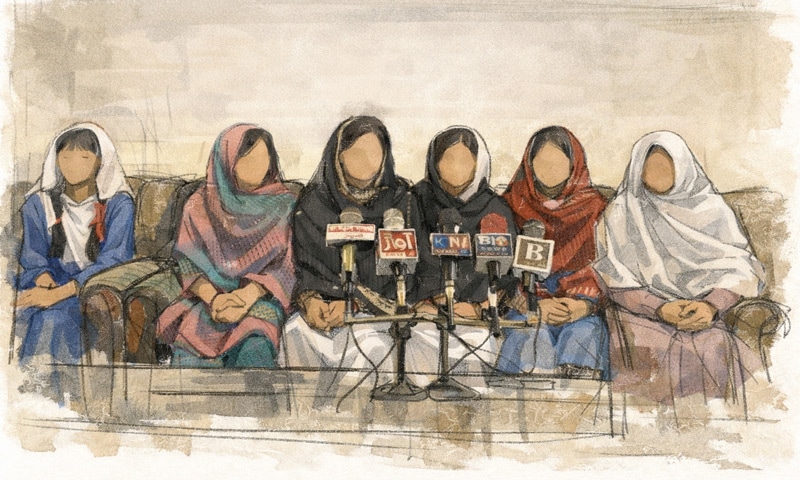
It was from this perspective that I followed reports emerging from a government girls’ school a few kilometres away in the town of Mirpur Sakro, also in Thatta district. In late November 2025, six girls, aged between 16 and 13 and belonging to the Hindu community, held a press conference, stating that they felt increasingly uncomfortable during classroom instruction.
“Our headmistress pressures us every day to convert to Islam, saying that our religion [Hinduism] is not good. She repeatedly pressures us to recite the kalma and convert,” one of them stated. Another said that the headmistress had also stopped them from participating in a school event on the same pretext.
After the students and their families approached local authorities and the press, the Sindh Education Department formed an inquiry committee. Administrative action followed. The teacher involved denied all allegations, maintaining that no coercion had taken place and that her intentions were misunderstood.
I do not write to determine the truth of competing claims. That responsibility belongs to institutional processes and due inquiry. What concerns me, as a teacher, is the experience described by the students — the perception that a classroom, meant to foster learning, had begun to feel threatening.
BEYOND ONE SCHOOL
What happened in Mirpur Sakro may appear isolated, but the anxieties it exposed are neither new, nor are they confined to a single school or district. Research and curriculum reviews have long indicated that Pakistan’s education system struggles to reflect religious diversity in a balanced and inclusive manner.
Independent textbook analyses conducted by organisations, such as the Centre for Social Justice, have documented a heavy presence of majority-religion references across grades one to 10, including in non-religious subjects such as Urdu, English and social studies. Minority faiths, by contrast, are either minimally represented or entirely absent.
Visual representation follows similar patterns. Textbook imagery frequently depicts mosques and majority-religion symbols, while temples, churches, gurdwaras and other minority places of worship appear rarely, if at all. Curriculum does more than convey information; it communicates belonging. When one religious identity is repeatedly presented as normative, students outside it may begin to feel peripheral — present, but not fully included.
This concern has been articulated by educationist Professor Abdul Hameed Nayyar, who has repeatedly warned against the insertion of religious content into non-religious subjects. Nayyar argues that such practices amount to ideological conditioning rather than education, and that they undermine both pedagogical ethics and constitutional protections. He has consistently pointed out that Article 22 of Pakistan’s constitution, which prohibits compulsory religious instruction of a faith other than one’s own, is compromised when religious messaging is embedded indirectly into science, language or social studies curricula.
According to Nayyar, the issue is not religion itself, but misplacement: faith may be taught in clearly defined religious studies courses, but not diffused across unrelated subjects where students cannot meaningfully opt out.
These dynamics can be particularly pronounced in rural and underserved areas, where institutional oversight is weaker and teachers often hold immense authority. In such contexts, students may feel unable to question or challenge what they perceive as inappropriate. Silence becomes a strategy of self-protection rather than a choice.
POLICY AND PRACTICE
In this context, a recent federal curriculum reform is particularly relevant. In 2023–24, the Ministry of Federal Education and Professional Training approved a religious education curriculum for grades I–XII, under which Islamic Studies is no longer compulsory for non-Muslim students.
Instead, students belonging to officially recognised other religions — including Christianity, Hinduism, Sikhism, Buddhism, Kalasha, Bahá’í and Zoroastrianism — are offered religion-specific courses aligned with their own faith traditions. The reform was introduced to bring classroom practice closer to constitutional guarantees of religious freedom and to reduce the sense of exclusion reported by minority students.
While this policy marks an important shift at the curricular level, its effectiveness ultimately depends on classroom implementation, teacher preparedness, and institutional oversight — areas where gaps continue to exist.
THE BURDEN OF AUTHORITY
As teachers, we are trained extensively in syllabus management, examinations and instructional methods. We receive far less guidance on navigating belief, identity and diversity — despite how frequently these issues surface in classrooms. They appear not as open debates, but as hesitations, silences and private conversations after class. Teaching ethics, like teaching itself, demands restraint as much as expression.
This reflection is not an argument against religion, nor a denial of its importance in society. Faith remains central to the lives of many students and communities. Public classrooms, however, must remain neutral ground. When belief enters lessons unrelated to faith, it risks transforming education into moral evaluation — even when no such outcome is intended. Being a teacher, this incident compelled me to write the following on my school’s notice board: ‘A school has no religion.’
Recent reforms acknowledge Pakistan’s religious diversity and constitutional commitments, but meaningful change depends on daily classroom practice. Teachers require continuous professional development on ethical boundaries, constitutional responsibilities, and sensitivity to diversity — not because harm is presumed, but because authority demands care. International teaching standards consistently emphasise that educators must avoid using their position to advance personal ideological or religious views unrelated to curriculum objectives.
When I look at my students, I ask myself whether they feel safe enough to speak freely, to disagree respectfully, and to learn without fear of judgment. Education depends on that freedom. Without it, classrooms may keep their timetables and their registers, but they cease to educate in any meaningful sense.
A classroom should never be the place where a child first learns to fear difference. It should be where curiosity is protected, confidence is nurtured and respect is practised — not enforced. Protecting that space is among the most serious responsibilities teachers carry.
Incidents like the one that transpired in Mirpur Sakro do not demand outrage alone; they demand reflection — by educators, policymakers and institutions alike. If education is to fulfil its promise, it must begin by ensuring that no child enters a classroom carrying the burden of fear.
Only then can learning truly begin.
The writer is an educationist and the principal of a government school in Thatta, Sindh.
He can be contacted at lalanaseemkazi@gmail.com
Published in Dawn, EOS, March 1st, 2026