Petition lands in SHC against e-ticketing system


KARACHI: A petition was filed in the Sindh High Court (SHC) on Thursday impugning the newly introduced electronic challan (e-challan) system in the metropolis and pleaded to declare its implementation, without prior adequate road infrastructure and ownership-verification safeguards, as illegal and unconstitutional.
The petitioner asserted that the e-challan system was introduced only in the city, while other divisions of Sindh remained exempt, and such unequal and selective implementation, despite uniform road tax collection, constituted hostile discrimination against Karachiites.
Citing the chief secretary, home department, excise and taxation department, inspector general of Sindh police, DIG-traffic police, Karachi mayor and others as respondents, petitioner Ahmed Nadeem Awan, said to be a leader of Pakistan Markazi Muslim League, through his counsel Muddasir Iqbal Chaudhry, approached the SHC.
He contended that the state cannot demand compliance and impose heavy pecuniary sanctions while failing to provide the basic infrastructure necessary for lawful driving, and that the impugned e-challan system was arbitrary, oppressive and discriminatory.
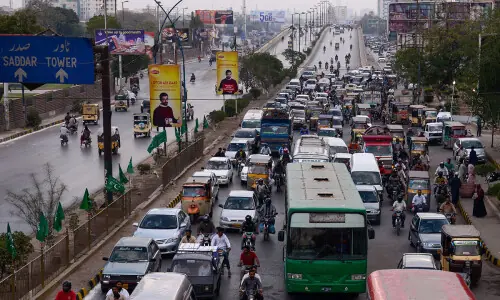
The petitioner also submitted that despite deteriorated infrastructure, faded road lane markings, non-functional traffic signals and lack of visible signage, the respondents have begun issuing heavy fines ranging from Rs5,000 to Rs100,000, as if citizens were driving on international-standard thoroughfares.
He further maintained that such disproportionate penalties, particularly in the context of dilapidated roads and unregulated traffic conditions, offended the principles of proportionality, fairness and reasonableness as guaranteed under Articles 4, 9, 24 and 25 of the Constitution.
The petitioner submitted that heavy financial penalties were being imposed upon vehicle owners without considering the deteriorated road conditions of Karachi, as many thoroughfares including University Road, M. A. Jinnah Road, Sharea Faisal and Korangi Industrial Area Road were broken, unmarked and under continuous excavation.
He also argued that when a citizen is forced to pay hefty fines for unavoidable traffic deviations caused by broken or unmarked roads, such imposition becomes a form of harassment rather than lawful regulation, and constitutes an excessive and disproportionate exercise of power, violating Articles 4, 9 and 14 of the Constitution.
He further submitted that the respondents have violated Article 25 (equality before law) of the Constitution by enforcing the impugned e-challan system only in Karachi, while other divisions of Sindh remain exempt.
This unequal and selective implementation, despite uniform road tax collection, constitutes hostile discrimination against the people of Karachi, he maintained.
The petitioner also contended that no effective appellate or redressal mechanism exists to challenge these wrongful e-challans, and citizens are compelled to pay fines to avoid harassment, which violates their right to access to justice and fair hearing under Article 10A.
In Punjab, he submitted, similar traffic violations under the e-challan system attract comparatively nominal penalties, demonstrating that effective enforcement can be achieved without excessive financial burden.
He further argued that the impugned e-challan system was implemented without ensuring requisite road infrastructure, ownership-verification mechanism or procedural safeguards for citizens and subsequent imposition of coercive measures including doubling of fines, blocking of CNIC, suspension of driving licences and impounding of vehicles upon non-payment fines amount to deprivation of property and legal rights without due process of law.
The petitioner maintained that the collection of over Rs10 million in fines within six hours after the enforcement of the e-challan system reflects that the scheme is revenue-oriented rather than safety-driven, and amounts to indirect taxation or compulsory exaction of money without lawful authority, prohibited under Article 77 of the Constitution.
He stated that the imposition of heavy fines despite unsafe and unserviceable roads is contrary to the constitutional principles of welfare and reasonableness, and pleaded to declare the impugned system, without prior adequate road infrastructure and ownership-verification safeguards, as illegal and unconstitutional.
While seeking interim relief, the petitioner also asked the SHC to suspend the operation and implementation of the e-challan system and restrain the respondents from issuing, processing or recovering any new e-challans until the final disposal of the petition.
Published in Dawn, October 31st, 2025