Pak-Saudi alliance
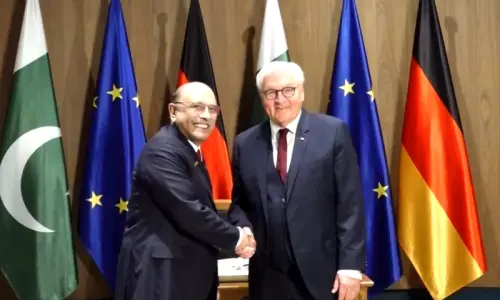
YEARS ago, I warned in these pages that Pakistan’s economic edge was slipping, with few goods competitive enough for global markets. The culprit? A failure to build world-class industries in key sectors. Japan, South Korea and other high-performing Asian economies had shown the way: amass capital, invest smartly in select industries, then dominate global markets with aggressive exports. Today, the September 2025 Pakistan-Saudi mutual defence pact opens a golden opportunity to follow this playbook.
If approached intelligently, it offers Pakistan a structural opportunity to fuse its security and economic imperatives. The mutual defence agreement needs to be augmented with a ‘Military-Industrial Vector’ (MIV), a joint enterprise that could unite Saudi Arabia’s financial strength, investments in technological innovation, and Vision 2030 ambitions, with Pakistan’s proven defence production expertise and military technical know-how, forging a dynamic axis for co-production, technology transfer, and global defence exports.
Pakistan craves export-led growth to revive its economy, while Saudi Arabia seeks to break free from oil dependence. Riyadh wants to localise over half its military spending. Meanwhile, the JF-17 fighter, co-produced by Pakistan and China, secured a landmark $4.6 billion export deal with Azerbaijan in 2025, proving Pakistan’s defence production prowess. This triumph sets the stage for Pakistan-Saudi collaboration. By uniting Saudi Arabia’s financial strength, technological innovation, and Vision 2030 ambitions with Pakistan’s proven expertise in defence systems, joint facilities can produce aircraft, drones, and sensors — for both nations’ and also for global markets.
The model is straightforward: Pakistan’s Defence Export Promotion Organisation and Pakistan Aeronautical Complex can serve as operational anchors, while Saudi Arabia’s Public Investment Fund, Export-Import Bank, and General Authority for Military Industries provide the financial and institutional muscle. The first step should be tangible — the creation of maintenance, repair, and overhaul facilities in Saudi Arabia for trainer and transport aircraft. Pakistan already has the technical expertise; Saudi Arabia has the resources and a growing cadre of engineers. These MRO facilities can service the kingdom’s fleet and simultaneously establish a foothold in the regional aviation market — making Riyadh a regional aviation leader.
The second avenue should prioritise high-impact, affordable tech like unmanned aerial vehicles and sensors. Pakistan’s drone expertise, combined with Saudi university research and engineering talent, could launch cost-effective products for global markets, from surveillance drones to smart sensors.
Pakistan can unify security & growth aims.
At the strategic level, the MIV must also think beyond hardware. The future of warfare is data-driven, and Pakistan’s emerging capability in satellite imaging and secure communications can merge producti-
vely with Saudi Arabia’s growing investments in space technology. Together, they can build an autonomous command-and-control network, modelled on Europe’s IRIS² — a secure, multi-orbit satellite constellation independent of the US, Russia, or China. It would also allow for civilian spin-offs: from flood monitoring in Pakistan to precision agriculture and broadband connectivity across the Gulf.
The MIV’s transformative potential hinges on innovation. A joint innovation fund, backed by both nations, would unite Pakistani and Saudi researchers to co-develop cutting-edge technologies — from satellite propulsion to AI-driven electronic warfare — co-owning the intellectual property. This ensures Saudi Arabia’s strategic independence and supercharges Pakistan’s innovation ecosystem. Civilian spin-offs are a bonus: satellite su-rveillance enhances Gulf port security, while AI algorithms improve regional disaster response.
The deeper value of the MIV lies not in one deal or facility, but in the discipline it can bring to Pakistan’s industrial planning. It offers a framework to link capital, technology, and markets — an area where Pakistan has historically faltered. Saudi capital can underwrite the long investment horizons that defence manufacturing demands; Pakistan’s industrial base and human capital can provide the production backbone; and jointly, both can pursue global export opportunities with far greater credibility than either could alone. If executed with intent, the MIV can become the nucleus of a broader regional ecosystem of defence and dual-use industries.
The Pakistan-Saudi defence agreement offers Pakistan a way to finally align its economic ambitions with its strategic imperatives. It is a blueprint for both nations to lead a regional industrial surge while securing prosperity for decades.
The writer is a strategist and lead author of Seeds of Prosperity: Planting the Ecosystems for Pakistan’s Economic Bloom.
Published in Dawn, October 17th, 2025