• Commercial farming in riverine areas raises concerns about river’s hydrology
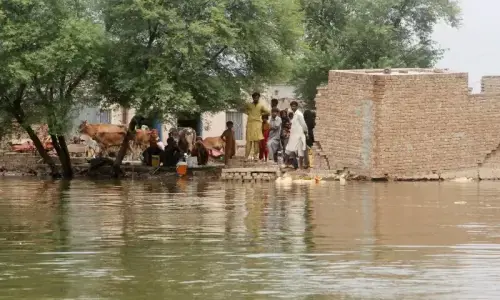
HYDERABAD: A landowner from upper Sindh’s riverine area (katcha), Arshad Pirzada, is waiting for floodwaters to recede in the pocket where his ancestral lands lie. His 50-acre piece of land is located some three to four kilometres from the Larkana-Sehwan river dyke downstream of Sukkur Barrage in Larkana district.
Historically, floodwaters have been a source of rejuvenation for the riverine area. Katcha dwellers grow crops — mainly wheat crop — after floodwaters recede from lands on the basis of residual moisture and without farm inputs. For them, floodwaters are always a blessing, but trends have changed as the scale of farming inside the riverine has increased massively, thus disturbs river’s hydrology.
This year’s World Rivers Day, which is celebrated on fourth Sunday of September, coincides with a medium flood’s peak passing Kotri Barrage on Sept 27. Floods usually pass this last barrage by mid-September. It was as far back as on Sept 30, 1992 when a high flood of 673,809 cusecs passed downstream of Kotri Barrage.
Pirzada says, “Trends have now changed for sure.”
Farming in the riverine area at many places has turned into a commercial venture, according to climate change consultant Naseer Memon, in recent past. Even corporate-style farming has become prevalent and the use of combine harvesters, which is hardly seen even in irrigated or settled areas of Sindh, is now a common sight. Bigger players have jumped in. They take land on a contractual basis there.
Sharing the details of the seasonal cultivation, Pirzada explains, “People grow channa [gram] as soon as floodwaters return to main river course after inundating the rest of the riverine belt followed by sarsoo [mustard] and then finally wheat. I had grown tir [sesame] in kharif season before flood’s arrival in our area but I had to harvest the crop as flows increased with short intervals this season,” he says, alluding to medium and high floods that passed through Guddu and Sukkur barrages since August.
Indus River downstream Guddu to Kotri barrage has a considerable length of dykes that makes river flow within two banks.
Sajjad Soomro, an engineer by profession, has been closely monitoring satellite imagery of the Indus River since the onset of the recent floods. “The average width of the dyke between Guddu and Sukkur barrages is approximately 16 km, and around 14 km between Sukkur and the Kotri reach,” he explains. “The floodwaters inundated the entire katcha area — barring high lands — between these three barrages, reaching the embankments on both ends, as confirmed by the images.”
The floodwaters passed safely through Sindh’s three major barrages, despite fears of a “very high” to “super flood” forecasted in late August when deluges from the eastern rivers entered from Punjab.
According to the Provincial Disaster Management Authority (PDMA), around 3.78 million acres of cropped land have been affected across 21 districts. The displaced population stands at 196,111 people as of September 25. Since no breaches have been reported in the main Indus River dykes, these figures presumably represent those living and farming in the katcha (riverine) areas.
“Farmers have significantly raised the surface level of their lands and built embankments around them,” notes Pirzada. “These elevated farmlands help avoid the costly relocation of livestock from the katcha to settled areas during flooding.” He adds that the floods play a critical role in recharging groundwater, a vital resource for these communities. “People now use lift machines powered by solar systems — a shift from the traditional diesel pumps — to access this replenished water for agriculture.”
While floods bring disruption, they also hold promise — especially for the struggling Indus Delta, where they are considered a source of economic revival. Continuous sea intrusion in the delta region has already led to massive displacement over recent decades and triggered long-standing demands for sustained freshwater flows downstream of Kotri to repel the encroaching Arabian Sea. In the districts of Badin and undivided Thatta, millions of acres of agricultural land have been swallowed by the sea.
Abdullah Murgur, a 74-year-old resident of Keti Bundar in Thatta district, recalls a more fertile past. “Our lands once produced vegetables, rice, and many valuable crops before the Indus was dammed,” he says. “The sea used to be about 75km from my village — now it’s only 25km away.” Still, he sees hope in the current floods: “These waters will bring abundant fodder and make the groundwater sweet again — at least for a while.”
Yet, experts warn of unsustainable practices. Naseer Memon notes that intensive agriculture in the riverine zones is upsetting the river’s natural dynamics. “We are unrelentingly tampering with the river’s ecology,” he warns. “Historically, katcha farming was small-scale and subsistence-based — mostly wheat grown after the flood season. Now, massive infrastructure has taken root, involving powerful actors at the highest levels of government and the state.”
Prof Dr Altaf Siyal, acting vice chancellor of Sindh Agriculture University (SAU), Tandojam, has studied water losses along the river system. “Since April, around 9.4MAF conveyance losses of water noted between Guddu and Kotri barrages. A major part or 80pc of 9.4MAF has gone into soil through seepage to recharge groundwater aquifer,” he says, explaining that 2.4MAF was lost between Guddu and Sukkur, and 7MAF between Sukkur and Kotri.
He believes the Indus Delta stands to benefit most from the recent freshwater flows reaching the Arabian Sea, which could help mitigate sea intrusion — provided such flows continue.
Prof Dr Iqrar Ahmad Khan, former vice chancellor of the University of Agriculture, Faisalabad, agrees with Dr Siyal. “Floodplains in both Punjab and Sindh — known for producing vegetables, pulses, oilseeds, and fodder — will see a rise in groundwater levels,” he confirms. “Normally, the water table drops by two feet annually.” However, he stresses the need to drain stagnant water from Punjab’s flooded fields in time to sow the upcoming winter crops.
Published in Dawn, September 29th, 2025