0
0

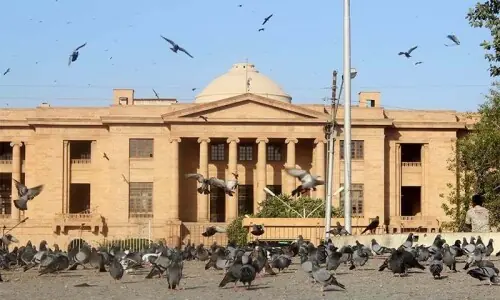
KARACHI: Expressing concern about the government’s inadequate response to higher courts’ verdicts regarding farmers’ rights, the Hari Welfare Association (HWA) regretted that the Sindh government filed an appeal in the Supreme Court of Pakistan against a pro-peasant verdict issued by the Sindh High Court (SHC).
A press release issued by the HWA on Monday reminded that in 2019, the Sindh High Court (SHC) ordered the Sindh government to provide relief to Ghulam Ali Laghari against his forced eviction by landlords, and also to revise the Sindh Tenancy Act of 1950 to assist landless sharecropping peasants. But instead of offering relief, the government of Sindh, in 2020, filed an appeal in the apex court against the pro-peasant verdict issued by the SHC.
Civil society representatives, including Akram Khaskheli, Manzoor Laghari, son of late Ghulam Ali Laghari, Advocate Ali Palh and others met with Advocate Faisal Siddiqui, a Supreme Court lawyer, to support the case.
Sindh Agriculture Minister Ismail Rahu had pledged in January 2020 that the government would not pursue an appeal against the judgment, but the Sindh government continued its pursuit in 2024.
In March 2024, under a Constitutional Petition No D 6265, the SHC ordered the government of Sindh to implement the Sindh Women Agriculture Workers Act (SWAWA) of 2019. The court also urged the government to draft rules.
The constitutional petition was filed by the Human Rights Commission of Pakistan (HRCP) and others, including the HWA, against Sindh and relevant departments in 2024.
The secretary of the labour and human resource department responded by outlining the government’s efforts to implement the SWAWA and asked the SHC to dismiss the petition, claiming the rules were in the final stages of approval. Despite the passage of five years, the act has not been implemented. Also, there has not been any progress on the Sindh High Court’s decision of March 2024, concerning the rule of the Women Agriculture Workers Act.
The HWA points out that, meanwhile, women agricultural labourers, especially cotton and chili pickers, continue to work under hazardous conditions. Many are exposed to toxic pesticides sprayed on crops, resulting in serious health risks and an increase in various illnesses among these workers.
The HWA appreciated that the government of Sindh has set the minimum wage for unskilled labourers in the province at Rs40,000. But it regretted that farm workers, including women, receive only between Rs10,000 and Rs15,000 after a month of hard labour. The HWA said that there is no mechanism to ensure the implementation of the minimum wage policy in any sector, especially the agriculture sector, in the rural areas of Sindh.
The HWA stated that, as a consequence, many families remain caught in cycles of poverty and debt, leaving them vulnerable to debt bondage. Each day, scores of workers and landless peasants are released on the orders of the lower courts, but due to a lack of political support, landlords often take them back from outside of the courts.
The district vigilance committees (DVCs) are set up in all 30 districts of Sindh but they play no role in the implementation of the Sindh Bonded Labour System Abolition Act. These DVCs do not play a role even in the rescue of the bonded labourers and protection after their release, which remains a serious and unattended concern.
Published in Dawn, September 23rd, 2025