WIDE ANGLE: CELEBRATING THE ORDINARY
I’m still excited when somebody makes a movie out of something that I’ve done,” Stephen King recently told The Guardian. This openness to exhilaration on King’s part is remarkable, given that he is such a widely adapted writer.
To date, more than 90 of his novels and short stories have been adapted for cinema and television (and more adaptations are currently in production).
Variations in the scale of his works have proved no barrier for potential adaptors of King. The 1,100 pages of The Stand (1978) have been processed for the screen. But so too have been the 110 of Rita Hayworth and Shawshank Redemption (1982). Genre shifts across the long arc of King’s work have also been accommodated by adaptors.
While early ventures in horror, such as Carrie (1974) and Misery (1987), were rapidly taken up by Hollywood, equal haste has been expended recently to bring to American TV King’s crime novels, featuring the likeable sleuth Holly Gibney from the Holly series.
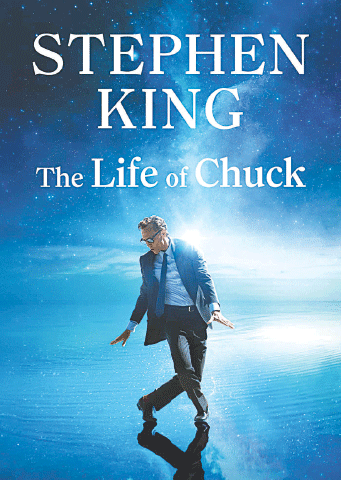
An adaptation of Stephen King’s The Life of Chuck celebrates the richness of ordinary life
In all of this furious adaptive activity, differences in quality are only to be expected. For every screen treatment with the lustre of Kubrick’s TheShining (1980), there is a dull or clumsy transposition, such as John Power’s two-part miniseries of The Tommyknockers (1993).
Even King’s involvement in a project is not a guarantor of success. His role as executive producer failed to
prevent Salem’s Lot (1975), his horrifying tale of vampires in Maine, from being defanged when it was adapted for cinema in 2024.
Now King is back as an executive producer, this time attached to The Life of Chuck, a film adapting one of the novellas included in his 2020 collection If It Bleeds. Here, however, he is working alongside something of a King specialist (if not a King obsessive), the screenwriter and director Mike Flanagan. He has already adapted two novels by the author: Gerald’s Game (1992) and Doctor Sleep (2013).
Happily, The Life of Chuck proves to be a thoughtful adaptation, shot through with King’s sensibility while augmenting the original novella through its own cinematic choices.
The Life of Chuck showcases King’s continuing interest in narrative experimentation, even in this late phase of a long writing life. Three acts, structured in reverse chronology, consider moments in the seemingly unremarkable life of Chuck Krantz (Tom Hiddleston), a New England everyman. Flanagan’s adaptation sensibly preserves this design.
There are a few instances in the film where the director appears inhibited by his source material. In his Guardian interview, King reveals himself to be pleasingly without any sense of proprietorship about the adaptive process, saying he thinks of his novels and short stories and the films made from them as “two different things, like oranges and apples.”
But where Flanagan draws verbatim on the novella for sustained passages of voice-over, especially in Act One, he is in danger of not sufficiently differentiating his apple from King’s orange.
Elsewhere in the film, however, Flanagan frees himself from King’s storytelling. More is done on screen than on the page to weave together the three acts, as when characters restricted in the novella to one segment only appear in other places in the film (a roller-skating girl, for example, or high school English teacher Marty Anderson, played by Chiwetel Ejiofor).
New motifs are included in one strand by Flanagan so as to prepare us, subtly, for another part of the story. Most notably, there is an allusion in Act Three to the 19th-century poet Walt Whitman, great celebrator of everyday American experience, who is an animating presence in Act One.
In praise of ordinariness
Film is a mixed or “composite” medium, having at its disposal not only the visuals of photography but the resources of other forms, such as architecture, dance, music and theatre. All are mobilised effectively in Life of Chuck.
A low-key score by the Newton Brothers is heard throughout, further endowing the several sections of the film with narrative continuity and atmospheric unity. The drumming that figures prominently in the middle section is echoed in Act One when Chuck’s rock‘n’roll-loving grandmother bangs the rim of a saucepan.
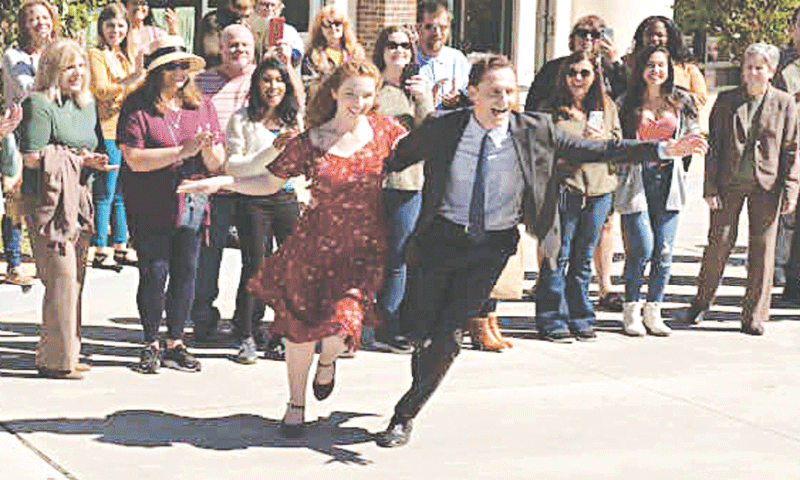
Dance, too, is central to The Life of Chuck as a screen experience. This is not an especially kinetic film: the camera tends to move smoothly, while editing transitions are generally stately (rationing the terrifying jump cuts common elsewhere in King adaptations). But there is vivid movement in the film’s middle section.
Recalling the extended set-pieces of Fred Astaire and Ginger Rogers musicals that we catch glimpses of when characters are watching TV, the adult Chuck frees himself from the constraints of life as a besuited accountant and spontaneously dances.
The dance is one of many moments in which The Life of Chuck celebrates the ordinary, uncovering its richness. Ordinariness has a long tradition in American writing (a field in which King, as a former English teacher, is
expert). Consider John Williams’ novel Stoner (1965), perhaps, or Raymond Carver’s short story A Small, Good Thing (1983).
But Flanagan has succeeded in the challenge he sets himself to bring ordinariness to a cinema screen that often, these days, is populated instead by images of the super-heroic and fantastical.
The writer is a Senior Lecturer in American Literature and Film at Loughborough University in the UK
Republished from The Conversation
Published in Dawn, ICON, September 6th, 2025