AFICIONADOS of spectacular martial displays will no doubt find today’s military parade in Beijing considerably more impressive than the one that marked 250 years of the US Army (as well as Donald Trump’s birthday) in Washington not too long ago.
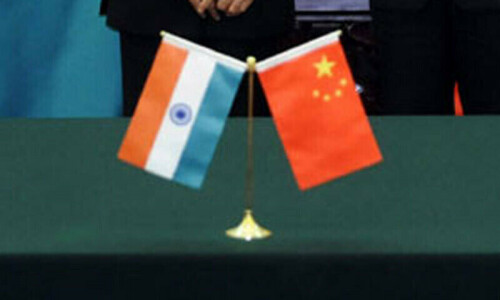
Narendra Modi won’t be there, perhaps because saluting China’s military prowess just five years after border clashes, and barely four months after Chinese technology gave Pakistan an edge in the post-Pahalgam hostilities, would not have played well at home. But at the Shanghai Cooperation Organisation summit in Tianjin over the weekend, he was holding hands with Vladimir Putin and Xi Jinping on what was the Indian prime minister’s first visit to China in seven years.
Apart from talks with Xi, he spent more than 45 minutes in Putin’s limousine. Obviously, we don’t know what they discussed. There was never much of a chance that Modi (if he was so inclined) could sway the Russian president from his aggression against Ukraine. The Chinese leader, meanwhile, held out the prospect of partnership in place of rivalry, and Modi expressed no disagreement.
This could be notched up as yet another triumph for the first seven months of Trump’s presidency. The non-alignment that India’s first PM judiciously favoured has left its marks, notwithstanding all of the relatively recent hostility against ‘Nehruvian socialism’.
While maintaining cordial ties with three US administrations, Jawaharlal Nehru was also attached to the idea of friendship with the Soviet Union and China. There have been fractures over the decades with Washington and Beijing, but the Moscow connection has survived the demise of the USSR.
China knows how to play the long game.
Russia, however, wasn’t a key source of crude oil until the sanctions following its attack on Ukraine. The irony is that until last year the US pretty much encouraged India to purchase Russian crude to maintain oil prices, and had no objection to the refined product being sold on to Europe or America, so that they could claim they weren’t buying it from Russia. The largest refinery belongs to Mukesh Ambani’s Reliance Industries, which helps to explain why a sudden halt to Russian imports would be a non-starter for the crony capitalism that has helped to sustain the BJP regime.
Previous US presidents wooed India as a counter-balance to China, as part of a strategy that has only persuaded the latter to extend its military prowess. Trump presumably knows that China imports more Russian crude than India, yet his aides have described the Ukraine conflict as ‘Modi’s war’ and derided India as a ‘laundromat’ for Russia. That’s absurd, given that Moscow would be disinclined to shift its aggressive stance as long as Beijing and Delhi are on board. The Ukraine war would not screech to a halt if India stopped purchasing Russian oil.
It might be different if China withdrew its support from Russia, but that too is unlikely. Inadvertently or otherwise, the US has facilitated rapprochement between India and China. ‘Hindi-Cheeni bhai bhai’ might remain a historical memory, but the South Asian region would no doubt benefit from unexpected bonhomie between the world’s two most populous powers. The days of ‘Howdy Modi’ and ‘Namaste Trump’ seem to be long gone.
Around the time of Trump’s second inauguration, a global poll indicated that India was among the very few Global South nations that saw his return to power as positive. Opinions have been shifting, though, and even the 52 per cent of Indians who approved of Trumpianism in June might be differently inclined after the 50pc tariffs threatening to strangle India’s economy.
That’s yet another obstacle in the path of India’s economic illusions, and it remains to be seen whether a prospective partnership with China might prove transformative. But Modi is also struggling domestically, after the disappointing last election and credible accusations of fraud. That may seem Trumpian in some ways, but the US and India are very different entities.
Both Modi and Trump benefit from largely ineffectual oppositions. That might change, and the aftermath could remain troublesome. It must be said, though, that Modi’s reported refusal to chat with Trump over the phone was more assertive than Pakistan’s deference to Washington. Neither side has offered a credible explanation for why the war stopped. Whatever the details, the outcome stretches beyond regional circumstances.
China’s transcendence might be a long time coming, but, unlike Trump, Xi knows how to play the long game. Could a better world order emerge?
It’s not impossible, but the scant mention in the Tianjin agenda of the genocide in Gaza and beyond serves as yet another reminder that trade trumps transgressions against human rights. China’s trajectory as a US rival remains shrouded in mystery, but Trump might solve it sooner than we expect.
Published in Dawn, September 3rd, 2025