Pakistan calls for boosting UN peacekeeping missions’ role to resolve disputes like Kashmir

Pakistan has urged a stronger role for the United Nations peacekeeping missions in conflict resolution, stressing that their enhanced involvement is urgently needed to settle long-standing disputes such as Kashmir.
Pakistan joined the United Nations shortly after gaining independence in 1947 and has played a prominent role in peacekeeping efforts, contributing to 48 missions in 29 countries since 1960.
Islamabad has repeatedly called for enhancements in UN peacekeeping, with Ambassador Asim Iftikhar Ahmad in April urging the integration of the use of advanced technologies to boost effectiveness.
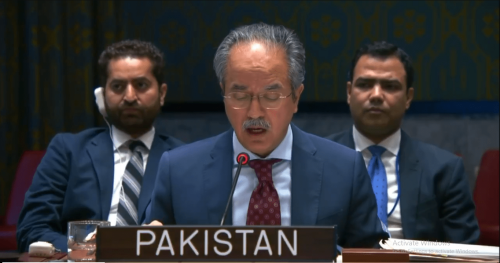
Ambassador Ahmad, while addressing the 15-member UN Security Council on Tuesday, said: “Nowhere is this more urgently needed than in Jammu and Kashmir, a longstanding dispute on the UN Security Council’s agenda.
“This Council, which mandates the missions, must ensure that missions are deployed with an accompanying credible political process that addresses the root causes of conflicts, and that mission mandates are demand-driven, clear, sequenced, and context-specific.”
The Pakistan envoy was speaking at a debate titled ‘Adapting Peace Operations for the Pursuit of Political Solutions’.
“This council should fulfil its obligations and make concerted efforts to secure a just and lasting solution to the Jammu and Kashmir dispute in accordance with relevant resolutions of the Security Council and the wishes of the Kashmiri people,” he added.
In his remarks, Ambassador Iftikhar highlighted Pakistan’s experience of nearly eight decades of engagement with UN Peace operations, saying the country had remained among the top troop contributors, host to one of the UNs oldest missions United Nations Military Observers Group in India and Pakistan, which monitors the Line of Control (LoC) in the disputed Kashmir region.
“We are also a founding member of the Peacebuilding Commission,” he said, pointing out that over 235,000 Pakistani peacekeepers have served with distinction in missions across four continents.
“A total of 182 of our bravest have laid down their lives in the service of peace. We greatly value the importance of the UN peace operations”.
In May, the UN honoured 57 military, police, and civilian peacekeepers from 32 countries, including two from Pakistan, who died serving in missions last year, at a ceremony marking the annual ‘International Day of UN Peacekeepers’. Two of them were honoured posthumously.
“Overall, peace operations are a success story,” said Ahmad, who is the UNSC President for July.
“With an annual budget of $5.5 billion, UN peacekeeping worldwide constitutes less than 0.3 per cent of global military spending.”
He pointed out that multiple studies have confirmed that peacekeeping reduces violence, protects civilians and helps sustain peace arrangements.
“All reform efforts must therefore preserve operational credibility, institutional memory and readiness of peace operations,” he said. “Peacekeeping is not a silver bullet, but neither is it obsolete.”
The Pakistani envoy said the success of peace operations depends on a strong political undertaking by member states, particularly the Security Council.
“Where the UN and the council retreat or hesitate, political vacuums emerge,” he said, noting that this vacuum is being increasingly filled by negative actors and soldiers of fortune, thus proliferating the threats to international peace and security.
“That space must be reclaimed through credible political processes, anchored by the Council’s authority and implemented through empowered UN missions.”
He urged that peacekeeping missions should put greater emphasis on promoting local peace arrangements at the community level wherever possible to reduce violence and build trust.
In April this year, while speaking at a UN peacekeeping meeting, Foreign Minister Ishaq Dar proposed a comprehensive reform of UN peacekeeping operations, urging the international community to adapt peacekeeping structures and strategies to meet the challenges of a rapidly changing global security landscape.
Also in April, Interior Minister Mohsin Naqvi reiterated Pakistan’s longstanding support for UN peace operations while speaking to UN Under-Secretary General for Peace Operations Jean-Pierre Lacroix, who called on him at the interior ministry.