HONG KONG: China’s Premier Li Qiang announced construction had begun on what will be the world’s largest hydropower dam, on the eastern rim of the Tibetan Plateau, at an estimated cost of at least $170 billion, the official Xinhua news agency said.
Commencement of the hydropower project, China’s most ambitious since the Three Gorges Dam on the Yangtze, was seized by Chinese markets as proof of economic stimulus, sending stock prices and bond yields higher on Monday.
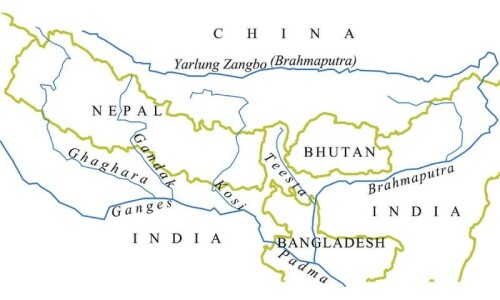
Made up of five cascade hydropower stations with the capacity to produce 300 billion kilowatt-hours of electricity annually, equal to the amount of electricity consumed by Britain last year, the dam will be located in the lower reaches of the Yarlung Zangbo. A section of the river tumbles 2,000 metres in a span of 50km, offering huge hydropower potential.
India and Bangladesh have already raised concerns about its possible impact on the millions of people downstream, while NGOs warned of the risk to one of the richest and most diverse environments on the plateau.
India, Bangladesh raise concerns about dam’s possible impact on millions of people downstream
Beijing has said the dam will help meet power demand in Tibet and the rest of China without having a major effect on downstream water supplies or the environment. Operations are expected sometime in the 2030s.
Broader impact
The Chinese premier described the dam as a “project of the century” and said special emphasis “must be placed on ecological conservation to prevent environmental damage,” Xinhua said.
Government bond yields rose across the board, with the most-traded 30-year treasury futures falling to five-week lows, as investors interpreted the news as part of China’s economic stimulus. The project marks a major boost in public investment to help bolster economic growth as current drivers show signs of faltering.
“Assuming 10 years of construction, the investment/GDP boost could reach 120 billion yuan ($16.7 billion) for a single year,” said Citi in a note. “The actual economic benefits could go beyond that.” China has not given an estimate on the number of jobs the project could create.
The Three Gorges, which took almost two decades to complete, generated nearly a million jobs, state media reported, though it displaced at least a similar number of people. Authorities have not indicated how many people would be displaced by the Yarlung Zangbo project.
The Yarlung Zangbo becomes the Brahmaputra River as it leaves Tibet and flows south into India and finally into Bangladesh. NGOs say the dam will irreversibly harm the Tibetan Plateau and hit millions of people downstream.
The chief minister of Arunachal Pradesh, Pema Khandu, said earlier this year that such a colossal dam barely 50km from the border could dry out 80pc of the river passing through the Indian state while potentially inundating downstream areas in Arunachal and neighbouring Assam state. Some experts also express concerns for a project in a seismically active zone.
Published in Dawn, July 22nd, 2025