Pulitzer Prizes 2025: Honouring excellence in journalism
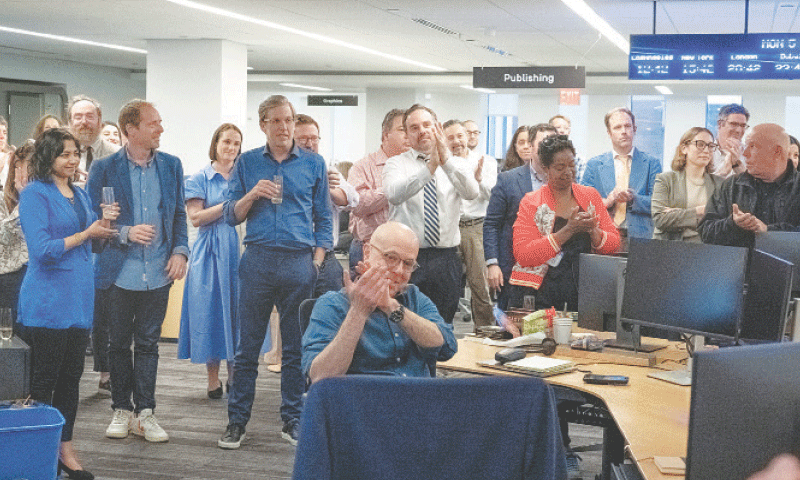

• NYT claims four prizes, setting record for most wins since the awards began in 1917
• Palestinian poet Mosab Abu Toha bags award for commentary
• Declan Walsh wins for his coverage of Sudan conflict
NEW YORK: The juries of Colombia University on Monday announced the winners of Pulitzer prizes in various categories, ranging from Investigative Reporting to Fiction.
Various journalists hailing from different news organisations, including Reuters, Agence France-Presse and The New York Times won awards for their outstanding work in journalism. Other winners of the most prestigious awards in American journalism included the New Yorker magazine, which won three, largely in recognition of their coverage of overseas wars.
Palestinian poet Mosab Abu Toha, who has been targeted by pro-Israel groups in the US for deportation, has won a Pulitzer Prize for commentary, Al Jazeera news reported. Abu Toha received the prestigious award for essays published in The New Yorker “on the physical and emotional carnage in Gaza that combine deep reporting with the intimacy of memoir to convey the Palestinian experience” of the conflict. The New Yorker also won for feature photography and audio reporting.
Other nominees from Gaza were four Palestinian photographers from AFP who were finalists for their Gaza coverage in the “Breaking News Photography” category.
Reuters won the Pulitzer in investigative reporting on Monday for a series of stories that penetrated the international trade in the chemicals used to make fentanyl, the drug at the heart of a crisis that has killed some 450,000 Americans and counting.
Reuters reporters, as part of their seven-part series, Fentanyl Express, purchased all the ingredients needed to produce fentanyl, revealing how the Chinese chemicals fuelling America’s synthetic opioid crisis are astonishingly cheap and easy to obtain and why US authorities are failing to stop the deadly trade. For just $3,600, the team bought enough precursor chemicals and equipment to make at least $3 million worth of the drug.
The series revealed for the first time how the chemical supply chain works and exposed how and why the US government has been unable to stem the flow despite major diplomatic and law-enforcement pushes by the Biden and first Trump administrations. The team was composed of Maurice Tamman, Laura Gottesdiener, Stephen Eisenhammer, Drazen Jorgic, Daisy Chung, Kristina Cooke, Michael Martina, Antoni Slodkowski and Shannon Stapleton.
The New York Times increased its total to 139 prizes — a record high since the awards began in 1917. This year, it won for breaking news photography for Doug Mills’ images of the July assassination attempt on Donald Trump, capturing a bullet flying through the air.
In explanatory journalism, it was honoured for its examination of the US war in Afghanistan; and in international reporting for Declan Walsh’s coverage of the conflict in Sudan.
The Times’ Azam Ahmed and Christina Goldbaum and contributing writer Matthieu Aikins won an explanatory reporting prize for examining US policy failures in Afghanistan.
In collaboration with the nonprofit Baltimore Banner, it also won the local reporting prize for an investigation into fentanyl’s impact on Baltimore, especially among older Black men.
The Trump assassination attempt was also the subject of the Pulitzer for breaking news reporting awarded to the Washington Post, one of two Pulitzers won by the newspaper. The other prize for the Washington Post went to editorial cartoonist Ann Telnaes, who quit in protest four months ago after a cartoon she submitted — one depicting Post owner Jeff Bezos and other CEOs kneeling before a statue of Trump — was rejected by the paper.
The coveted public service award went to ProPublica for its reporting about pregnant women who died after doctors delayed their care for fear of violating strict abortion laws.
The winner for national reporting was the Wall Street Journal for its examination of the “political and personal shifts” of Elon Musk, the world’s richest man and the architect of the Trump administration’s initiative to slash the size of the federal workforce.
African American themes also held a prominent place in the awards, including a special citation awarded to the late Chuck Stone for coverage of the civil rights movement. In the arts and letters, Percival Everett won in the fiction category for James, a reconsideration of Huckleberry Finn that gives a voice to the Black character Jim.
Palestinian finalists
The jury for the award praised the “powerful images” from Gaza by Mahmud Hams, Omar Al-Qattaa, Said Khatib and Bashar Taleb. The photographers’ work encapsulated “the enduring humanity of the people of Gaza amid widespread destruction and loss,” they said.
The Pulitzer nomination crowns an exceptional year for Hams, who also won the News award at the Visa pour l’Image festival in Perpignan and the Bayeux Calvados Prize for war correspondents — two of the most prestigious international awards in photojournalism.
Since the start of the conflict, virtually no journalist has been able to cross into Gaza, which borders Israel and Egypt. “This recognition is a tribute not only to the talent and bravery of these photographers, but also to AFP’s steadfast commitment to documenting events with accuracy and integrity, wherever they unfold,” Phil Chetwynd, AFP’s global news director, said in a statement.
“We are deeply grateful to Mahmud, Omar, Said, and Bashar, whose work gives voice to those caught in the heart of the conflict,” he added.
Published in Dawn, May 7th, 2025