IT need not have come to this. A week ago, Interior Minister Mohsin Naqvi had to issue a formal guarantee to foreign investors that their investments would be “secured at all costs”.
According to news reports, the interior minister assured a delegation of foreign investors that the authorities had taken notice of recent “attacks by miscreants” and that “legal action was being taken” against them. While details were scant, it seemed from the minister’s remarks that violence targeting foreign fast-food chains was a major discussion point on the investors’ agenda.
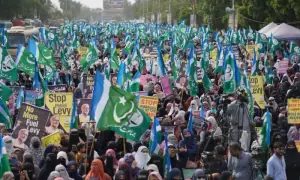
Allegedly instigated by a religio-political party, mobs had attacked and vandalised at least 10 fast-food outlets in different parts of the country early in April, during nationwide protests against the violence being perpetrated on Gaza. In one such incident, a restaurant worker was fatally shot by unidentified miscreants. The question is, where was the state when the attacks kept occurring day after day?
Promises and guarantees ring hollow after preventable loss of life and property has already taken place. And they serve little by way of assuring investors when there are many other accompanying examples of state failures resulting in business disruptions.
Consider, for example, that some of Pakistan’s most important logistics routes remained shut for 10 days because of a political dispute over new canal projects that the authorities had long refused to address. News reports stated that road closures by protesters in Sindh had forced many local manufacturers to suspend production due to raw material shortages, and even threatened a fuel shortage upcountry. The blockade also left millions of dollars’ worth of exports stranded on the highways, besides bringing much of domestic commerce to a standstill.
Throughout that period, the state did little but watch and wait while businesses suffered the costs of its catastrophic miscalculation on the canal issue. And who can forget last year, when the entire IT industry was made to suffer while the authorities toyed with Pakistan’s internet services on various pretexts.
These are just a few of the many ‘unforeseen yet not unexpected’ disruptions investors routinely face. Due to the prevailing sociopolitical instability and because its institutions are weak and the state has gradually undermined its own writ, investors face a heightened risk that their routine business operations may be completely upended at a moment’s notice.
This ‘normalised unpredictability’ is anathema to the operational continuity and development of businesses, as its risks and costs are invariably borne by them. Given how much time it invests in attracting investors to Pakistan, it is inexplicable why the government does not put in consistent effort to ensure the rule of law, the absence of which is what eventually drives investors away. Addressing symptoms of the problem but not its root causes can only yield temporary successes.
Published in Dawn, May 5th, 2025