Students and civil society march in Karachi against canals project, warn of looming ‘water wars’



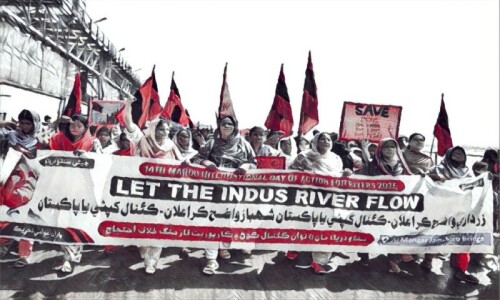
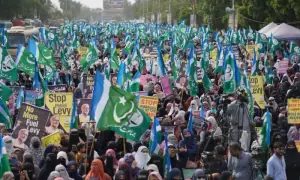
Hundreds of protesters, led by students from Karachi and other parts of Sindh, rallied alongside civil society members on Tuesday to denounce the controversial canals project, warning that looming “water wars could erupt into civil unrest” across the metropolis.
On February 15, Punjab Chief Minister Maryam Nawaz and Chief of the Army Staff General Asim Munir inaugurated the ambitious Cholistan project to irrigate South Punjab’s lands amid public uproar and strong reservations in Sindh. The Sindh Assembly also passed a unanimous resolution against the project in March.
The past few months have seen nationwide protests from political parties and civilians against the proposed canal project.
On the joint call of the Save Indus Students Alliance and the Karachi Bachao Tehreek (KBT), protesters marched from the Teen Talwar towards the Fawara Chowk today, carrying placards and chanting slogans to decry the existing water woes in the province.
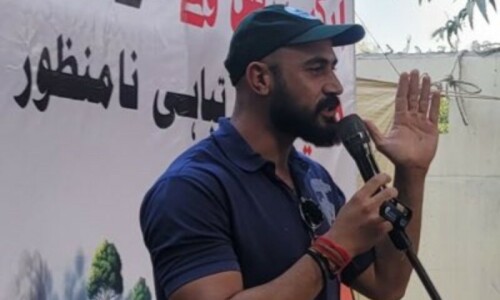
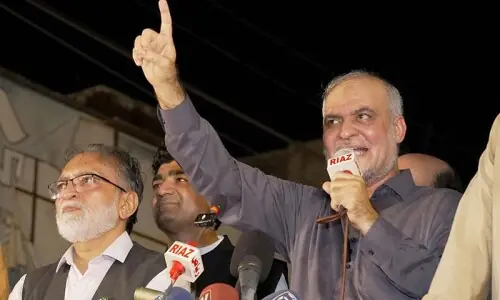
Speaking to Dawn.com, Muneer Hussain, a leader of the Save Indus Student Alliance and a student from Sindh’s Hala, said students from across Karachi were united against the canals issue.
“Karachi’s water is sourced from the Sindhu River, and the construction of new canals will drastically reduce the city’s supply. If that happens, water wars could erupt and spread across Karachi like civil unrest,” he said.
“The citizens [of Karachi] need to understand that the issue is not specific to farmers but an issue of survival for everyone.”
The protesters also gathered outside the Governor House for a brief moment, claiming that the city’s governor had accepted the project before the public outcry.
Bisma Barkat, a member of the KBT organising committee, told Dawn.com, “There are multiple voices present [at the protest] from all walks of life in Sindh. It does not make sense to not be one of those voices because this issue is existential for some [people].”
She called the canals project a “theft of land, water and rights of the people”, adding that “the capitalist interests combined with the state want to take away the rights of the common man [and] what belongs to the common man.”
Speaking on how the project would affect Karachi, Barkat said that 85 per cent of the city’s water came from the Keenjhar Lake, which was fed by the Indus River.
“If more canals are built on the Indus River, that water won’t reach Keenjhar, and ultimately, it won’t reach the common man in Karachi,” she said.
She continued, “If you do not get water, how do you run a metropolitan city that runs your factories and industries, which employ the poor?
“Even if canals are drawn, the golf courses [in Karachi] will still be maintained, but it is the poor people of Karachi who will be most affected,” she added.
Earlier in the day, Sindh Chief Minister Murad Ali Shah urged lawyers and opposition parties protesting the planned construction of six new canals on the Indus River to avoid causing public inconvenience by blocking highways during demonstrations.
“Please, continue your protest, we support it, but do not cause suffering for the public,” he said while addressing a press conference in Karachi.
Calling the protests by lawyers and opposition parties “good” as they supported the cause of Sindh’s people, Shah urged demonstrators to be mindful of public inconvenience.
“They should also consider the difficulties faced by the people and take care of that,” he said.
“Protesting by blocking roads and causing pain to your own people of Sindh — is this a protest?” he asked.
Later in the day, PPP lawmakers staged a walkout of the Senate session in protest against the contentious canal project amid an ongoing dispute with coalition ally PML-N.