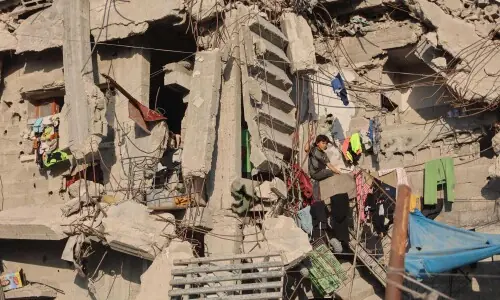
The Indian federal government took over direct control of the restive northeastern state of Manipur on Thursday after the region’s chief minister resigned amid ethnic violence that has killed at least 250 people over two years and displaced thousands.
One of India’s smallest states, Manipur has seen intense clashes between its majority Meitei and minority Kuki community since 2023, when a court suggested that economic benefits and job quotas granted to Kukis also be extended to Meiteis.
The imposition of the so-called president’s rule on an Indian state means it will be governed directly by the federal government through the federally-appointed governor.
Manipur’s current governor, Ajay Kumar Bhalla, is a former interior ministry bureaucrat.
In the notification issued by India’s interior ministry, President Droupadi Murmu stated that the decision was made based on a report from the Manipur governor and other information received regarding the matter.
“I am satisfied that a situation has arisen in which the government of that state cannot be carried on in accordance with the provisions of the constitution,” she stated.
Manipur’s Chief Minister N Biren Singh, a Meitei leader and a member of Prime Minister Narendra Modi’s Bharatiya Janata Party (BJP), resigned last week but was asked by the governor to continue until alternative arrangements were made.
He had been under pressure from opposition groups and his own allies to step down.
The National People’s Party, a key BJP ally in the state, had also withdrawn from the ruling coalition in November citing Singh’s failure to resolve the crisis, but local media reported on Wednesday that it had returned to the fold.
Modi’s government has blamed the sectarian violence partly on an influx of refugees from Myanmar, which borders Manipur, and Singh said in December that he believed normalcy would return to the region in 2025.
Around 16 per cent of Manipur’s 3.2 million population belongs to the Meitei community, which controls the more prosperous lowlands, while around 16pc are Kukis, who live in the hills.