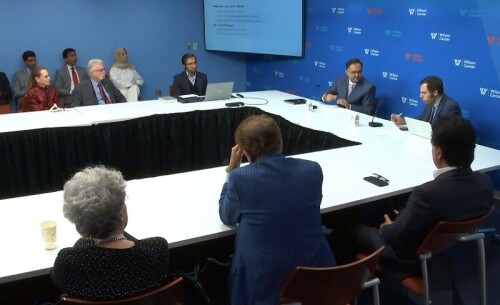
The US administration has sought a budget of $101 million for Pakistan to “strengthen democracy, fight terrorism, and stabilise the country’s economy”, US Assistant Secretary of State Donald Lu told a congressional panel on Tuesday.
Lu’s statement came as he presented a written budget request for South and Central Asian Affairs to the House of Representatives Foreign Affairs Committee.
He said that Pakistan was facing “ongoing challenges and opportunities”, in light of which, the requested funding would strengthen democracy, fight terrorism, and stabilise the economy by supporting economic reforms and debt management.
“The President’s Budget requests a straight-lining of our $101 million Pakistan budget,” Lu said. “That money would be used to strengthen democracy and civil society, to fight terrorism and violent extremism, and to support economic reforms and debt management to help stabilise Pakistan’s economy.”
The US has consistently pushed Pakistan to uphold democratic values. Last month, the US House of Representatives adopted a resolution by an overwhelming majority in the US Congress, expressing concerns about the state of democracy and human rights in Pakistan. Islamabad responded strongly, rejecting the concerns as unfounded.
Similarly, Washington has repeatedly emphasised its “shared interest” with Pakistan in addressing the critical threat that terrorism poses to the entire region.
Budget request to prevent Islamabad’s ‘overreliance’ on Beijing
The president’s budget, according to the budget request document, was seeking a total of $1.01 billion in foreign assistance for the South and Central Asia region to “compete with the People’s Republic of China (PRC), counter Russian and Chinese disinformation, and prevent terrorist groups from threatening the US security”.
Of the total amount, the US announced it would redirect additional resources to South Asia, and to that end, the president had requested $585.7 million for the region, representing a 4.8pc increase over the 2023-24 budget.
Commenting on Pakistan’s economic relations with China, Lu said that the US was seeking to prevent Islamabad’s “further overreliance” on Beijing.
Responding to a lawmaker during the hearing regarding Washington’s plan to balance China’s “strong and growing influence” in Pakistan, Lu said that the US would supersede Chinese investments.
“China is the past in terms of investment; we are the future,” Lu said.
Pakistan is the third biggest recipient of Chinese development finance worldwide with a portfolio of $70.3 billion, a study revealed last year.
Only 2 per cent of China’s portfolio in Pakistan between 2000 and 2021 consisted of grants while the rest was in the form of loans, the study added.
Last year, Beijing rolled over $2.4 billion in loans to Pakistan during a financial crisis for the latter for two years.
China had repeatedly helped Pakistan to avert a default amid low foreign exchange reserves through debt rollovers while Islamabad was struggling to win over a staff-level agreement with the International Monetary Fund (IMF).