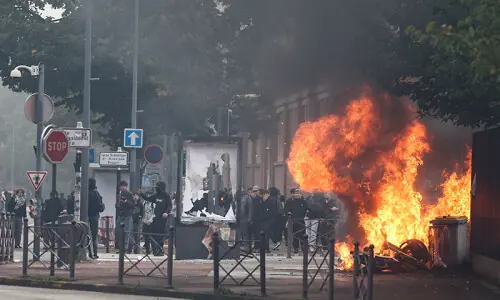
PORT AU PRINCE: Haiti’s troubled capital was put under a state of emergency for another month on Thursday as authorities struggle to rein in violent gangs demanding the prime minister resign.
The decree, published in the official gazette, came as the gangs — who already rule significant parts of Port Au Prince — extended their control with further attacks on law enforcement.
The UN’s humanitarian office warned that Haiti’s health system was “nearing collapse”, with many facilities closing or reducing services and a shortage of medicine and staff.
On Wednesday, gangs again targeted police by setting fire to a headquarters in Bas-Peu-de-Chose, a neighbourhood in the capital. Officers escaped before the attack, which also destroyed several police vehicles, according to Lionel Lazarre, the head of Haiti’s police union Synapoha.
The well-armed gangs plunged Haiti into chaos last week in a coordinated campaign while Prime Minister Ariel Henry travelled abroad, beginning with an assault on two prisons that allowed the majority of inmates to escape.
Further attacks have targeted the country’s airport and law enforcement facilities. Synapoha said that 10 police stations have been destroyed, and at least 15,000 people are estimated to have fled the worst-hit parts of Port Au Prince.
Gunshot wounds
On Thursday the UN’s humanitarian office called for an end to violence to allow aid to enter the country, reporting a lack of “blood, beds and staff to treat patients with gunshot wounds.”
The UN Security Council met in New York on Wednesday to discuss the “critical” situation in Haiti, while the United States has called on Prime Minister Henry to take steps to resolve the crisis.
Jimmy “Barbecue” Cherizier, an influential gang leader in Haiti, has warned of civil war unless Henry resigns.
In power since the 2021 assassination of president Jovenel Moise, Henry was due to leave office in February but instead agreed to a power-sharing deal with the opposition until new elections are held.
When the unrest broke out, Henry was in Kenya to negotiate a UN-backed multinational police mission to stabilise his country.
Published in Dawn, March 8th, 2024