0
0
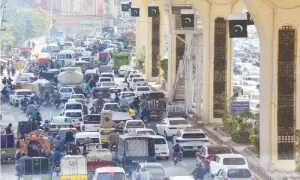
LAHORE awakened once more on Tuesday to a thick veil of smog, an unwelcome annual guest that refuses to leave. Its residents have been living with hazardous air quality, with the city often earning the dubious distinction of being the world’s most polluted. Despite the government’s effort to combat the problem, the situation remains dire. An Air Quality Index reading of 439 recorded early Tuesday makes evident the severity of the issue. To put things into perspective, an AQI below 50 is considered safe for breathing. Of late, Lahore’s AQI has consistently remained several times above the threshold, plunging its citizens into perpetual health and environmental jeopardy. Alarmed by the deteriorating situation, the Lahore High Court yesterday ordered the city administration to impose an emergency. This sinister shroud, often blamed on meteorological conditions, is at its core a man-made crisis with far-reaching consequences. Air pollution from vehicular emissions, industrial processes, construction projects and solid fuel use are all contributors. Farmers who burn crop residues post-harvest further exacerbate the problem. Industrial emissions and construction dust are also instrumental in smog formation. Furthermore, weather patterns, especially stagnant air during winter and temperature inversions, worsen the situation by trapping pollutants near the ground. New Delhi, situated across the border from Lahore, faces a similar environmental crisis with near-identical causal factors, which adds to the problem.
The authorities have not been idle, having recently established an anti-smog monitoring cell. Commissioner Muhammad Ali Randhawa has issued stringent orders, including water sprinkling on roads, crackdowns on stubble burning, and checks on brick kilns. Special teams are dispatched to industrial areas, and emissions control systems are being enforced. Traffic police are utilising Safe City cameras to take action against vehicles emitting smoke. Over 1,090 kilns have adopted zigzag technology, pyrolysis plants have been shut down, and cases have been registered against crop residue burning, besides penalties imposed on vehicles and kilns. Section 144 is in effect across the division, banning practices that contribute to smog. While these actions are commendable, it is crucial to recognise that the smog crisis demands a comprehensive and sustained response. The government must continue to intensify its efforts, enforce regulations rigorously, and engage in long-term strategies to mitigate the root causes of this crisis. The health and well-being of Lahore’s citizens and the environment they inhabit depend on it.
Published in Dawn, November 2nd, 2023