0
0
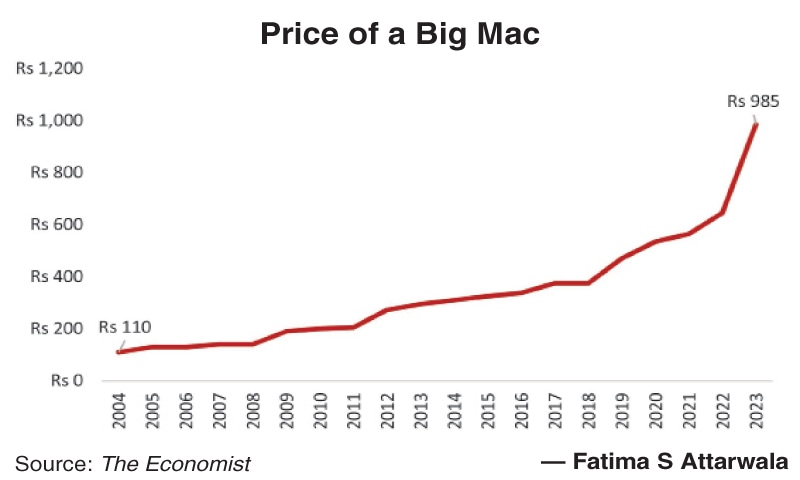
In the US, McDonald’s is a poor man’s meal — cheap and fast. In Pakistan, it is an indulgence for the middle-income group.
In 1986, The Economist invented the Big Mac index as a lighthearted guide to comparing currencies based on the theory of purchasing-power parity. The concept, purely theoretical, is that in the long run, exchange rates should move toward the rates that would equalise prices of an identical basket of goods.
So, if a Big Mac costs Rs985 in Pakistan, it should cost roughly $3.3 in the US (assuming $1=Rs300).
That a Big Mac costs $5.58 in the US implies an exchange rate of Rs176.52 for $1, indicating that the rupee is undervalued by 41%.
Does it mean that the rupee will come down to below Rs200? No. But it generally indicates that the deflated value of the rupee is not its real value. However, the economic demand and supply factors at play for the exchange rate are far more complicated than comparing burger prices.
More pertinent, perhaps, is the skyrocketing price of the Big Mac. Over the last two decades, the price has increased 8x times. Mac Donald’s prides itself on the length and taste of its fries, which require a special kind of potato, not grown in Pakistan.
To maintain quality, other ingredients are imported as well. Given import restrictions and rupee depreciation, it is not surprising that a Big Mac is 53pc more expensive today than a year ago.
Logic dictates that average burger prices will be cheaper in poor countries than in rich ones because the labour costs are lower. Thus, a Big Mac should cost less in Pakistan because the server standing behind the counter making McFlurries is making less than his counterpart in the US, not only because of the difference in the currency he is being paid but also because of how far his salary can stretch to pay his bills.
Published in Dawn, The Business and Finance Weekly, August 28th, 2023