New discoveries in Swat's ‘City of Alexander’ amaze explorers

SWAT: The archaeologists and cultural activists have said that the new explorations on the top of the ancient city of Bazira can attract tourists from around the world and boost cultural tourism.
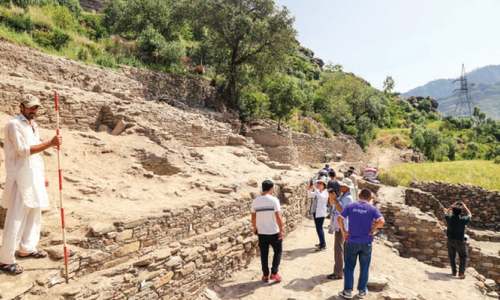
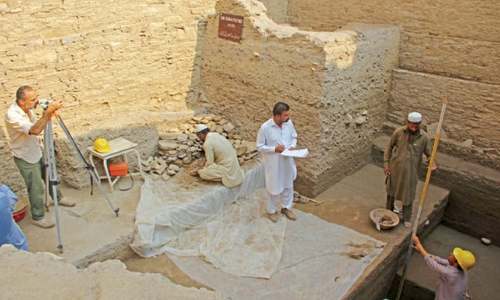
They said that Italian archaeological mission in collaboration with department of archaeology unearthed bastions, walls and stairs of the fort of the Ghwandai hill in Barikot.
Dr Luca Maria Olivieri, the head of the mission who led the excavation campaign, said that the archaeologists discovered some of the grand bastions, towers, walls and amazing drain work on the top of Ghwandai in Bazira.
Govt asked to properly preserve Bazira to boost cultural tourism
Bazira is an ancient city in Barikot tehsil of Swat, popularly known as the ‘City of Alexander’. According to experts, it is a major archaeological site after Taxila.
Dr Michele Minardi, another Italian archaeologist who was part of the excavation team, said that since the top of Ghwandai hill was strategically important for the ancient Swat from where major parts of the valley were monitored, the new discovery was of great importance.
“After the new development, we can see four main round towers on the corners of the hillock, on top of which were a huge water tank, monitoring towers and other auxiliary structures that were probably built in the Kushan period and were used in Turk Shahi, Hindu Shahi and Ghaznavid periods,” he said.
Dr Minardi said that the new discovery helped them to understand the entire structure of the castle on the top. He said that the archaeologists found the entrance point to the top of the hill which was amazing.
Cultural activists said that Bazira was one of the important sites, not only of Swat but also of the entire country where grand structures of the ancient times were discovered.
“It is a huge site with tangible and intangible history. The government must install a protection wall around the site with proper pedestrian paved ways, stairs to the top of Ghwandai and resting areas for the visitors,” said Amjad Ali, a cultural activist in Swat.
He said that that the sites of Taxila, Takht Bhai, Harappa and Mohenjo-Daro were properly protected so Bazira must also be protected in the same way.
The cultural activists said that gates should be installed and an entry ticket should also be launched for the visitors.
Published in Dawn, November 19th, 2021