PAKISTAN is the only country that our single-passport-holders can call home and that is why when bad things happen to it, those without options get butterflies in the stomach. Hope after the emergence of the PTI on the national scene is now fading, not only because of the ineptitude of its members but also because of flawed systems in the country.
It is a system where a convicted politician, who has jumped bail, is roaring from his luxurious haven abroad and holding everyone responsible for his misfortunes and the system can’t do a thing. This very system has not been able to convict a single leader, despite hundreds of court cases and televised court appearances by the high-profile figures.
The system in which the accused is the favourite child, especially the one who can afford clever legal advice, provides at least three different tiers of appeal with no limit to the time allowed. Resultantly, no crook in the country has ever been convicted on a sustainable basis.
And when in frustration extra-legal options are exercised both by the state and a frustrated individual, everyone cries foul and talks about the rule of law.
When loot and plunder continue, the system grinds to a halt.
How can a society hope for the rule of law if the system is incapable of punishing its criminals, looters, rapists and murderers? On the other hand, in a perverted paradox, state institutions like NAB are registering highly publicised cases against all and sundry, including state functionaries, without getting convictions. So on the one hand, crooks in this country feel safe and continue with their crooked ways having mastered the system, and on the other, the good ones who had kept the system going have been scared into their holes.
While loot and plunder continues, the day-to-day system has come to a halt. State functionaries no longer see any reason to be decisive or proactive. Any iota of remaining idealism has been eliminated.
The wheat and sugar crises are the result of scared state functionaries who make sure they take no decision for fear of being arrested and disgraced a few months later.
Both these sectors require timely decisions. Wheat requires timely decision on the procurement prices, how much and at what pace to procure; the timely ordering of imports; how much and when to release government stocks; interprovincial movement etc. It is a constant battle of wits between the trader/profiteer and the state. And like in all organisations all decisions are not correct.
It is the fear of making a mistake for which there is no provision in the system that makes things worse with the government increasingly talking tough.
While the present set-up’s inability to understand and control the functioning of government is contributing to the confidence level of the opposition, the most damning proof of the performance of our erstwhile rulers was the recent news about Bangladesh.
Fifty years ago, they were our poor relative, now their GDP is signicantly more than ours. Their population is at least 30 million less than ours even though religion is equally ingrained in that society if not more.
Their per capita income, which is the gold standard of economic progress, has already surpassed ours. This is despite all their problems of limited land, no natural resources, and a fragile political system. And our past rulers don’t stop reminding us of their ‘achievements’ of building motorways, and powerhouses; they want their rule to continue.
More than the past, the future seems scarier, amongst other things, because of the incompetence of the present rulers.
We are not heading towards a debt trap, we are already in it. Last year alone, the country added Rs4.3 trillion to its debt; that is equal to its total tax receipts. External debt went up by $17.8 billion over the last two years while total earnings from export are only $22bn or so. Our earnings from export have only grown by $6bn in 15 years while our external debt has increased by $78bn in the same period.
So what more of a trap do you need when every year your total indebtedness is increasing by an amount equal to your total tax receipts and when your foreign indebtedness has gone up by $17.8bn in two years, which alone is equal to 80 per cent of your annual exports?
This is despite the Musharraf regime realising the problem and the passage of the Fiscal Responsibility & Debt Limitation Act, 2005, which fixed the maximum debt at 60pc of GDP. No one bothered about the law in their desire to make political points, when ‘mega projects’ became the new political mantra and guarantee for election victory.
This is no jugglery of statistics but a situation more dangerous than internal terrorism. It will lead to the breakdown of law and order and the weakening of defence of the country.
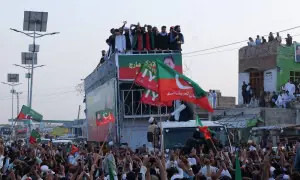
And we as nation are obsessed with how many people attended a jalsa and who raised slogans at the wrong location.
The writer is a former civil servant.
Published in Dawn, October 28th, 2020