Decide what you want before jumping into war, Mattis advises US leaders



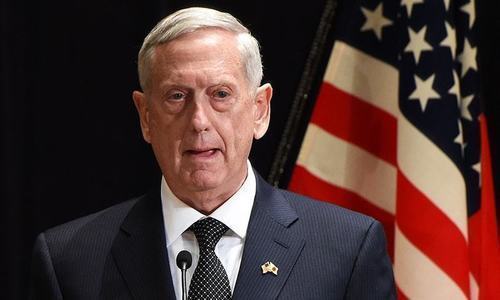
WASHINGTON: America’s political leaders and their military commanders have had serious differences over wars in Afghanistan and Iraq. But ultimately, it’s the elected representatives who prevail, says former US defence secretary James Mattis.
In his just-released memoirs Call Sign Chaos, Learning to Lead the former general also refers to President Barack Obama’s 2010 decision to sack “our four-star” Nato commander in Afghanistan, General McChrystal. Although Mattis describes McChrystal as “a superb leader”, he notes the commander “was rightly held responsible and fired” over his staff’s disparaging remarks about President Obama.
In a chapter titled ‘Snatching Defeat from the Jaws of Victory’, Mattis tells the reader how and why US military commanders often disagree with the country’s political leadership. He holds President George W. Bush responsible for pushing the United States back into Iraq in 2003. “Invading Iraq stunned me. Why were we fighting them again?” he asks.
He is equally critical of President Barack Obama and Vice President Joe Biden’s decision to order an unplanned and premature withdrawal from Iraq, Obama, he notes, also ordered a hasty pullout from Afghanistan without consideration for what’s happening on the ground.
Although Mattis does not mention President Donald Trump by name, he does criticise his isolationist policies and warns that it threatens America’s global standing. He served as Trump’s defence secretary for two years but resigned after disagreeing with his alleged isolationist policies. “What you have got to do is figure out what it is you intend to do at the outset [of a war] and then hold firm to that and don’t half-step it,” says Mattis in a book-interview to NPR radio. “I think that we have had serious policy challenges in figuring out exactly what it is we intend to do and then holding firm to that vision.”
Bin Laden’s escape
Mattis also blames his predecessor at the US Central Command, General Tommy Franks for Osama bin Laden’s escape from Tora Bora. Mattis had asked for the deployment of US Marines around Tora Bora to take out Bin Laden during the Dec 2001 operation. Franks turned down his request.
In a chapter on the Afghan war, Mattis blames the British for “separating [India and Pakistan] in a bloody partition that cost approximately a million lives.”
Mattis writes that in Sept 2011 General John Allen, who replaced Dave Petraeus as Nato commander in Afghanistan, told his Pakistani counterparts that the Haqqani network was preparing a massive truck bomb inside Afghanistan. “Two days later, that bomb detonated at a US base near Kabul, wounding 77 American soldiers and killing five Afghans. A few days later, Haqqani terrorists attacked our embassy in Kabul,” he writes.
At a diplomatic function in Washington, Mattis approached the then Pakistani ambassador to the US, Husain Haqqani, and slammed him with what he describes as “obscenity-laced” message. “You say you’re not on their side, but now they attack our embassy in a raid coordinated from your side of the border. You’re supporting the very people who will kill you one day,” Mattis had told Ambassador Haqqani.
Published in Dawn, September 6th, 2019