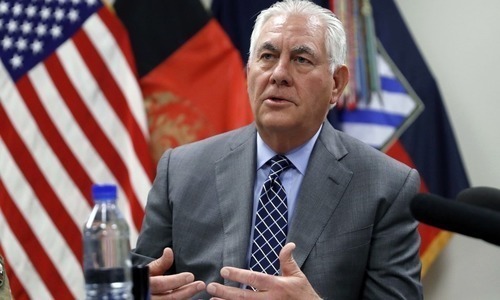
US will eradicate terrorism, with or without Pakistan: Tillerson


WASHINGTON: US Secretary of State Rex Tillerson has said that he did not visit Islamabad earlier this week to lecture or coerce Pakistanis but he did tell them that Washington is determined to eradicate terrorism from the region with their support or “in a different way”.
“And that’s not a threat. It’s just a matter of fact. We have to deal with the conditions on the ground. And as you know, the entire South Asia strategy is a conditions-based strategy,” he said.
Mr Tillerson said the message he delivered to Pakistan during the visit was: “Here’s what we need for Pakistan to do. We’re asking you to do this; we’re not demanding anything. You’re a sovereign country. You’ll decide what you want to do.”
On Thursday evening, Secretary Tillerson reviewed his seven-day visit to Europe, the Middle East and South Asia with the State Department press corps from Geneva, also highlighting key points of his talks in Islamabad on Tuesday. He said he had offered to help Pakistan resolve its disputes with India, a suggestion that may irk New Delhi, which opposes any third-party mediations with Pakistan.
“That would be a complete mischaracterisation of the meeting,” said the top US diplomat when a journalist asked him if it would be accurate to say that he received a message of defiance from the Pakistanis who told him, “We will not be coerced”.
But he acknowledged that he told them Washington would implement its new strategy with or without Islamabad because “this is what we think is necessary. And if you don’t want to do that, don’t feel you can do it, we’ll adjust our tactics and our strategies to achieve the same objective a different way”.
Says he offered to help Pakistan resolve its disputes with India
Secretary Tillerson said he viewed US-Pakistan ties as “a respectful relationship” but, “we have some very legitimate tasks, some very legitimate concerns that we need their help addressing. I said to them, ‘You can do it or you can decide not to do it. And if you decide you don’t want to do it, just let us know. We’ll adjust our plans accordingly and we’ll deal with it ourselves’ ”.
Another journalist referred to Indian media reports that Lashkar-e-Taiba chief Hafiz Saeed was not on a list of 75 terrorists that the US team handed over to Pakistani officials in Islamabad on Tuesday. The journalist also referred to a Pakistani media report that none of the 75 terrorists on the US list were Pakistanis and asked Secretary Tillerson to comment on both reports.
The secretary ignored the two points, saying instead that he had “a very healthy exchange of information on terrorists” with the Pakistanis. “We have provided them specific asks, beyond just names of individuals. We’ve provided them specific asks,” he said. “But we’ve also invited greater sharing from them as well. So we expect to receive information from them that will be useful.”
The United States, he said, was mainly interested in specific information about the location and movements of these terrorists, instead of indulging in the dispute whether they were based in Pakistan or Afghanistan. “As you know, the Pakistan-Afghan border is quite porous; in fact, it’s ill-defined. And so we’re less concerned about are they in Pakistani territory, in Afghanistan territory, or — as we are obtaining information so that we can eliminate them,” he said.
Mr Tillerson said he also explained President Donald Trump’s new strategy for South Asia in his discussions with Afghans, Pakistanis and Indian leaders, which requires the involvement of regional players — particularly India and Pakistan — for restoring peace and stability to Afghanistan.
“Pakistan is a key partner for the stability of the region. We have a long history of positive partnership with Pakistan, but Pakistan must do more to eradicate militants and terrorists operating within its country,” he said.
“The people of Pakistan have much to gain from a stable, peaceful Afghanistan, and a region that denies safe haven to terrorists. This was my principal message to Prime Minister (Shahid Khaqan) Abbasi, Chief of Army Staff (Gen Qamar) Bajwa, and the Pakistani leadership.”
He rejected the suggestion that he was lecturing Islamabad from Delhi and Kabul, which irritated Pakistanis. “I would not have characterised my direct discussions with them as lecturing at all. It was a very good and open exchange,” he said.
“In fact, we probably listened 80 per cent of the time and we talked 20 per cent. And it was important to me, because I have not engaged with Pakistani leadership previously. And so my objective was to listen a lot, to hear their perspective.”
The meetings in Islamabad, he added, provided both sides to share their views.
“We put our points forward. We put our expectations forward in no uncertain terms. There has been significant engagement prior to my visit, and there’ll be further engagement in the future, as we work through how we want to… exchange information and achieve the objective of eliminating these terrorist organisations, wherever they may be located.”
Published in Dawn, October 28th, 2017