1
1
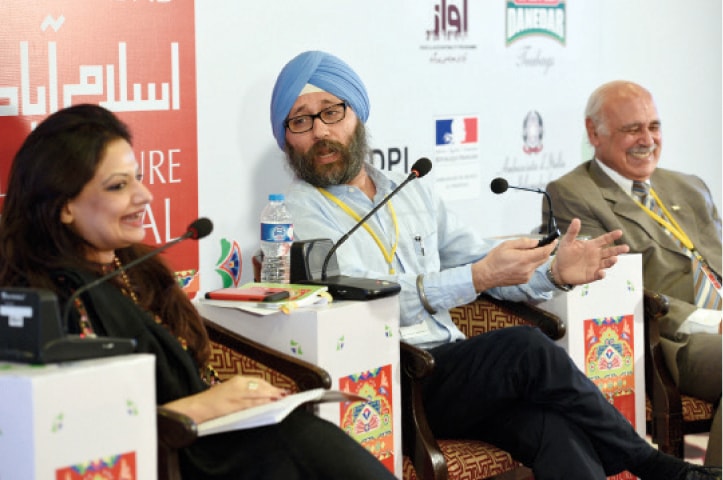
ISLAMABAD: At an Islamabad Literature Festival session on Pakistan’s Sikh heritage, Amardeep Singh recounted his “personal quest” in search of his community’s roots - a quest that led him to 36 sites in 30 days during his first visit to Pakistan, and 90 more in 45 days during his most recent trip.
The panel discussion, titled Lost Heritage: The Sikh Legacy in Pakistan, was held on Saturday, the second day of the festival. It featured Mr Singh and FS Aijazuddin, moderated by Reema Abbasi.
At the start of the session, Mr Singh spoke about how he came to write his book, after which the session was named. Calling himself an “accidental author”, Mr Singh said he was never destined to be in academia and spent 25 some years in the financial sector. But, he said, the history of the subcontinent was always “simmering inside” him. He credited his parents, who were from Muzaffarabad and Abbottabad but moved to Uttar Pradesh after partition, for telling him about what they had left behind in their native regions.
Mr Singh said when he would ask young members of the Sikh community where they would go if they could freely travel to Pakistan, they would talk about Nankana Sahib, Punja Sahib and Dera Sahib gurdwaras. He added: “I would think, were my forefathers so incompetent that that is all they made?”
The session wove through the history of the subcontinent, from the Sikh empire under Ranjit Singh to partition, as the speakers discussed a Sikh legacy that went beyond simply religion. “Legacies are bigger than religion,” Mr Singh said. “I have not done a work on gurdwaras. Even the introduction to this session was about the temples of Pakistan - this is not about the temples of Pakistan, it is about a legacy.”
He explained the book can be divided into two sections: the “functional” and the “vestiges” of the Sikh heritage in Pakistan. The functional ones are around 22 gurdwaras which have been maintained by the Pakistani government, but within the vestiges, Mr Singh said, is potential for Pakistan to become an area that attracts tourists. As he flicked through a short presentation on his work, including pictures of abandoned sites that make up part of the region’s Sikh heritage, Mr Singh told the audience: “Open it up, restore it; it’s your heritage. It’s nothing less than the frescos of the Golden Temple in Amritsar.”
Mr Singh also talked about how history and heritage are viewed today, saying: “We may suppress the Sikh era in the books in Pakistan’s universities, [but] the reality is Baba Bulleh Shah has written about it. You can’t suppress that.”
Ms Abbasi then asked Mr Singh to talk about his greatest disappointment when covering Pakistan’s Sikh heritage. Mr Singh said the challenge was the emotion he had to grapple with. “You are going to a country, and walking the streets and seeing your heritage. My estimate is that 80pc of the Sikh empire is in Pakistan. And the entire community in 1947 chose to walk away. The more delve into the [history of the partition], I say, you know, we could have coexisted on both sides.”
“When I walk around and see 70pc of the heritage is finished... The gurdwaras, the mansions, everything – the mohajirs who came they had to live somewhere. They did not associate with that heritage – they did not destroy it, but in seven decades, things have started falling apart.”
Published in Dawn, April 16th, 2017